Showing posts with label Kurt Weill. Show all posts

February 09, 2010

Song: "Die Moritat von Mackie Messer" - Friends Around the Campfire sing Kurt Weill

With Miss Minnie Molly Mary and the two Germans in my house, we recorded "Mack the Knife" last night (with the original Bertolt Brecht text).


Download this mp3 free here:

April 05, 2008

Song of Dung & Defenestration - Soul Ballad Version #2

No use to beat on the dull-drums
Let's be imagina-tive,

Each day is numbered

No good when slumbered

With only one life to live

-Ira Gershwin, lyrics to the Kurt Weill song "One Life to Live", from Lady in the Dark (1941)


Leighbor is a neighbor who does your labor.

-Pele, from a gmail chat, 3 April 2008.

Madam, I may be President of the United States, but my private life is nobody's damn business.

-21st President Chester A. Arthur

Attention to those of you with infinite patience for my increasingly surreal poetry readings, & home-computer recordings, oozing towards fulfilling a life goal of being included in the next Songs in the Key of Z. This may be the crown-jewel low point - my classic nonsense poem, Song of Dung & Defenestration, has been raped & mutilated, to the tune of my dying Yamaha PSR-500 Synthesizer. Mr Olaf Mary & Mr Epcar-Singer-Songwriter were kind enough to discover the accompaniment style "Soul Ballad #2", which is used to here to great effect. To read the original poem & hear an earlier recording of me chanting it, please visit this page: http://www.itwaslost.org/2007/10/song-of-dung-defenestration.html.
To hear the Soul Ballad #2 Version, listen right here right now!
It is also downloadable at this MySpace: http://www.myspace.com/ssandrigon. Or you can download it here.


And, as a weekend reading suggestion, Justin Davidson of New York Magazine discusses the oeuvre of the New York contemporary ensemble Alarm Will Sound, which includes several of my high-school friends. I can't wait to hear their nit-picky live version of Revolution #9, & the rest of their new 1969 project, which I'm told will include Berio's weird Beatles arrangements.

November 06, 2007

Music Review: Waits sings Weill

How Brecht's infatuation with antisocial hooligans can be reconciled with the strict Marxist doctrine that the writer adopted after 1926 is something that scholars have long struggled to comprehend. In a 1930 article, Walter Benjamin proposed that Brecht's thugs should be understood as promising material for revolutionary transformation...
-Alex Ross, The Rest is Noise: Listening to the Twentieth Century (2007), pg.191

Both my sister & my friend Chadwick were at this fundraiser concert a few weeks ago, where, they tell me, before Neil Young & way before Metallica (whom it seems no one stuck around to see), Tom Waits sang with the Kronos Quartet & a bass player. My brother-in-law said they played "Keep the devil way down in the hole", one of my very favorite Waits songs, & Chadwick reported that they sang one of the Weill/Brecht "Threepenny opera finales", probably "What keeps mankind alive?", which is on his last album & on a Weill tribute album.

Kronos is no longer seen as a Rorschach inkblot test for new music, which is just as well, & their adventures in gypsy music & Bollywood, denounced by many as "crossover", are better than, for instance, their performances of Lutosławski or that awful Terry Riley premiere. But anyway, their collaboration with Waits is not just meant to be hip or opportunistic. It's also acknowledging another large strain in underground/cabaret American semi-classical music. I just finished reading Alex Ross's intense book, a narrative of twentieth century classical music, & I was wondering who was going to be mentioned when. Waits is mentioned once in relation to Harry Partch's 1941 hitchhiking song-cycle Barstow (for unoperatic baritone & Adapted Guitar). Opposite of Copland's "New Deal" orchestral style & heartland idealization, Ross writes, "a lot of people would be hard-pressed to identify Barstow as 'classical music' at all. It comes closer to the twisted white blues of Frank Zappa, Captain Beefheart, & Tom Waits." (pg. 482) One of the lyrics, which Partch copied down from graffiti while traveling, is: "Here she comes, a truck, not a fuck, but a truck. Just a truck."

Tom Waits has ties not just to blues & lounge-music, but also European cabaret (although, like American underground music, it was often more popular than the Donny Osmond or Paul Hindemith stuff.) And, I'm told that Tom Waits' music is more revered in Germany than America, just as The Threepenny Opera was a hit during World War II here while it was banned by the Nazis. When, in the 1980s, Waits' orchestrations started to include marimbas, trombones, accordions, anvils, & his lyrics went beyond Dylan's abstractions, he was often more innovative than his classical counterparts - & there's a definite Weill connection, deliberate or not. My friend James Eliot Quill says he has created an entire lyrical world, full of characters & moods, as intricately rendered as Tolkien's thousand page fantasies. Also, his career has produced great albums in the 70s, 80s, 90s, & especially in the last few years - how many other artists can you say that about?

Macheath, a.k.a. Mackie, the antihero of The Threepenny Opera, is the nastiest of Brecht's homunculi. He is based on the character of Captian Macheath in John Gay's eighteenth century ballad opera The Beggar's Opera, which served as the main source for Brecht & Hauptmann's libretto. In the original, Macheath is a master criminal with a dashing style who stands in metaphorically for the corrupt politicians of Gay's time. Benjamin, in a later essay on The Threepenny Opera & its sources, observed how "intimately the countermorality of beggars & rogues is interwined with the cant of official morality." Brecht & Weill's Macheath is at once more charming & more menacing that Gay's, mainly because of the musical number that introduces him: "Die Mortitat vom Mackie Messer," otherwise known as "Mack the Knife." This most famous of Wiemar songs takes the form of a "murder ballad," a catalog of killings. Macheath is revealed not merely as a high-living highway man but as an apparent psychopath who kills as much for pleasure as for financial gain. Schmul Meier has disappeared, along with many rich men; Jenny Towler is found with a knife in her breast; seven children die in a great fire in Soho; a young girl is raped.

-ibid. pg. 191


So Mackie is more violent than his predecessors, reflective of a violent time, & foreshadowing. Ross writes, "Weimar culture exhibited an unhealthy fixation on the figure of the serial or sexual killer." Hmmm. I'm also in the final thralls of The Sopranos, which is about a charming, complex, family-man gangster boss. There is also a "countermorality", the captains often speak of their "soldier's code." It should also be noted, that the "catalog" of Tony Soprano's violence & crime, beyond words or ballads, although he never rapes, definitely outdoes Mack.

There's also this new please-give-me-lots-of-Oscars movie, American Gangster, which David Denby just reviewed. "Like many modern gangsters, Frank [Lucas] wants to turn crime into a rational enterprise; he wants to lead an orderly & loving family life, & to play his game so stealthily that he will never be tainted by what he does." Denby is a bit taken back by the glamorization of Lucas (who is a pure capitalist, & reeks ravage on his black community by way of cheaper heroin), without as much retribution as, say, The Godfather. At the end of Die Dreigroschenoper, of course, Mackie is saved & redeemed by "Victoria's Messanger" - compare that Gilbert & Sullivan ending to what happens in American Gangster: Frank Lucas's mother slaps him across the face. In both cases, ouch! I don't know what happens in the end of The Sopranos, don't tell me.

...Weill's song thus became a showbiz tour de force, although its sting remained. Armstrong & Sinatra, both children of the streets, understood what the text was about: Armstrong said that Mack the Knife reminded him of characters he had encountered in New Orleans, while Sinatra knowingly grafted on a line from Francis Ford Coppola's Godfather films, which exposed American politicians as gangsters of a higher order.

-ibid. pg. 193

July 02, 2006

Music Review: 10 Suggestions for Summer Listening! Part I

Here I present five of ten albums in various genres, hand-picked from the very favorites of my music collection. Some of the hyperlinks are audio samples, powered by Amazon.com.

CLASSICAL
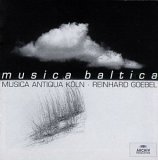
Musica Antiqua Köln (directed by Reinhard Goebel) – Musica Baltica (1999)

This could become an essential album to anyone whose music collection lacks obscure composers of the Baltic Mid-Baroque (late 17th Century). It is also, hands down, the finest early music violin playing I have ever encountered, led by savant-genius Reinhard Goebel. He guides his ensemble thru the frolicsome flares necessary to any well-researched project of period-instrument Baroque performance, but one never feels bogged down in the mordents. He has also introduced me to some of the most haunting & unusual music. It is a long album, but don’t miss the final tracks, with two by Johann Valentin Meder, the controversial Danzig Kapellmeister. The Sonata di Battaglia begins with triumphant C-major chord which saws away for a solid two minutes before changing! Also, the regal trumpets & bassoons on Vincenzo Albrici’s Sonata a 5 continue to move me, after years of repeated listenings, to minuetting around the room.

_________________________________________________________________________________


Dawn Upshaw – Osvaldo Golijov: Ayre, Luciano Berio: Folk Songs (2005)
Stand up for the Crossover disc of the decade! The pairing of Berio's 1960's take on combining world folk genres with contemporary classical innovations, with Golijov's 21st Century attempt, leaves a lot to think about. Golijov is the Jewish-Argentinian-American who did all of those amazing, yet popularly denounced, arrangements for Kronos Quartet's Caravan (gypsy) & Nuevo (latin) crossover experiments. (Kronos fan-purists would prefer them to keep with the heady academic program, but really they're just keeping up with more realistic trends & innovations - their newest album is all from Bollywood soundtracks.) Golijov's own music, for instance in Ayre, has a ton of integrity whilst dipping into every imaginative world idiom. Clearly, if the 21st century offers any direction, it's welcoming inspiration from the sheer bulk of recorded music available, & relishing in its ability to be blended in the genre of notated concert music. Berio's Folk Songs have been recorded dozens of times, but this ensemble is especially tight, & the piece has really worn well during its transition from contemporary classic to over-preformed classic-proper. Dawn Upshaw, I think, is one of the most amazing vocalists alive. She can keep her day job at the conservative Metropolitan Opera while preforming the classiest new music & anything else she wants to: Weill, Bernstein, Ives, Berg, Adams, Purcell, Stravinsky, &c. Her voice is really just an instrument of her intelligence, tastely borrowing slides from jazz, an occasional hugeness from Wagner, & deepening it with her own gravity or lightening it with her wit. Golijov's music allows her to showcase a new breadth, replete with sufi trills, or whatever the music calls for. As for Berio, "I wonder as I wander" has never sounded so beautiful.

_________________________________________________________________________________


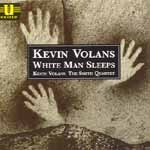
Kevin Volans - White Man Sleeps (1990)

1980s British Minimalism is one of the sadly neglected genres of 20th Century Music. Graham Fitkin, for instance, perhaps suffers from a contemporary embarrasment for cheezy synthesizers. His seminal Cud (1988) perhaps sounds a bit too much like The Muppets Take Manhatten. Many recordings by Fitkin have not been reissued - (Look for Argos CDs in used record stores!) Volans, however is the opposite in aestetic - his music is extremely earthy. A white South African native who moved to Dublin, several of the pieces on this album are for two harpsichords tuned liked African thumb pianos (a compositional risk, I assume, severely limiting performance possibilities). Kronos Quartet has recorded the string quartet version of White Man Sleeps, an arrangement of the version on this album for two harpsichords, viola da gamba, & percussion. The Smith Quartet preformance on this album, I cannot emphasize enough, rocks so much harder than Kronos. Really, man, this is some of my favorite music. Like Steve Reich, it clearly links '70s-'80s Minimalist form to traditional African counterpoint, written for early Western instruments, & performed with a lot of heart.

______________________________________________________________________________


Steve Reich - You Are (Variations) (2005)

I am curious how Reich-virgins might approach this music, because, more than ever, he is building on a career's-worth of innovations. It has the form of Tehillim - (two two-part movements, lots of soprano-cannon-lines sung in hebrew, third movement slow). It has the thick piano writing of several earlier pieces, but his dissonence has deepened, like in Four Quartets. It has similar repetitive-philisophical-text-setting as The Desert Music & Proverb. Melodically, the second movement of You Are starts with a jumpy-hebraic melody reminiscient of Tehillim, which gets dissected in a way similar to The Desert Music, so that the words are slowed down into luscious chords, amidst thick pulsing pianos & percussion. I feel that Reich has yet to really disapoint, nor are developments of previous ideas ever boring (or, like Glass, pathetic.) This piece, despite borrowing from an entire career, feels fresh, original, & even a tad rebelious. His mystic-contemplative side is as deep as ever, his harmonies as luscious - everything - his pace, ochestration, drama, everything that makes music good, is of the finest quality. I guess one should consider this an excellent piece of music grown from a carefully developed style, which has evolved over four decades. Also, on the same album, is Maya Beiser's performance of his latest Counterpoint, Cello Counterpoint, a series of pieces where one instrumentalist plays on top of herself twelve-or-so times. This has by far the fastest changing structure & some of the richest harmonies of any of them. It's beautiful, recorded with gorgeous production.

_____________________________________________________________________________


ROCK / COUNTRY

Emmylou Harris - Wrecking Ball (1995)

In September, we'll be celebrating the 11th anniversary of this seminal album. What links it to 90's country music, or 90's rock? I don't know. It sounds more to me like someone has stuck this album in a future capsule from 2050, where Emmylou's plastic head has been preserved in a laboratory. Her voice is both alien & earthy. It aches as Jesus must have, yanked between two universes. The lyrics of the songs she chooses to sing are like a snow plant, organic but a seeming stranger - "And if you were Willie Moore / And I was Barbara Allen / Or Fair Ellen all sad at the cabin door /A-weepin' and a-pinin', for love / A-weepin' and a-pinin', for love." It's really the production that makes this music so special, tho. Daniel Lanois, who has also worked with Bob Dylan, U2, & Peter Gabriel, matches Harris' alien-earthy dichotomy with his own magic. What is the "wrecking ball"? Is it what happened to the rolling stone? A symbol for one generation, which began as aimless, & ended somewhat heartless & destructive? Neil Young sings back-up on his own song, "meet me at the wrecking ball / I'll wear something pretty & white / & we'll go out dancing tonight." Every song carries a subtle mystical overtone, subtle even when she's singing directly to her "savior". Her version of Gillian Welch's "Orphan Girl" is my favorite of this oft-covered song. (I sing it with a ukulele). &, of course, "All My Tears" is one of the most beautiful things ever recorded.

March 22, 2006

Movie Reviews: Movies about Artists

Date: Tue, 21 Mar 2006 18:34:37 -0800 (PST)
From:
Send an Instant Message "Melinda Rice" <_____________@yahoo.com>
Subject: Walk the Line
To:"j welsch" <____________@yahoo.com>, Send an Instant Message "Rebekah Goldstein" <_________@yahoo.com>

In the new movie, Walk the Line, Reece Witherspoon plays June Carter, and Joaquin Phoenix plays Johnny Cash. It's a tale of youth pursued through adulthood (Cash), and Joaquin Phoenix sings as Cash throughout the movie (Reece Witherspoon sings as Carter, too, with a southern drawl).

The Carter family is portrayed as level-headed in the few scenes they enter, in contrast with the fire between Cash & his father. In one memorable scene, after a Thanksgiving dinner gone sour at Johnny's new home, as Johnny Cash fumbles angrily in the mud with his new tractor, and June says: I don't know what will happen if I go down there, her father memorably replies: Honey, you already are down there.

The credits are the first time that Cash and Carter's actual voices are heard, and they make it clear what the viewer has been missing all along in the movie. Joaquin Phoenix and Reece Witherspoon are good actors, and do a valiant job at singing like their characters (Phoenix has a darn low voice), but they just don't have the patience in their voices.

_________________________________________________________________

Date: Wed, 22 Mar 2006 09:14:53 -0800 (PST)
From:"James Welsch" <___________@yahoo.com>
Subject: Ray
To:Send an Instant Message "Melinda Rice" <___________@yahoo.com>
Hey man,

Have you seen Howl's Moving Castle. It's the last Miyazaki film.

I was tired of rock-star / biopics after Ray. It seemed to me there was more to his life than watching him do drugs & his wife yelling at him. It was essentially the same movie as Pollack, The Doors, Kurt Weill: A Biopic, Frida, Amadeus, & That One about the Black Painter. They're all about artists doing a lot of drugs, their wives yelling at them, & an occasional shot of someone singing & an audience digging it, or a successful art opening. Ray ended triumphantly with him quitting heroin, as if that was his crowning achievement, thirty years before his death.

James