Showing posts with label magic. Show all posts

February 11, 2009

Videos: Black Magic & Lost Time

Japanese Magician in blackface doing his Obama tricks:


& John Hodgman in blackface giving his TED lexure on love & lost time.


The Elizabeth Gilbert lexure for Ted is also really inspiring, if you need that sort of thing:
http://www.areasofmyexpertise.com/2009/02/i-have-returned-from-the-bohemian-grove/
Hodgman convinced me to join Twitter, so if you're on that, befriend me!

November 17, 2008

Song of Supposition

How come I no longer carry a pen?
And where has the rum gone?

The internet is for politics & perverts,

So long as you come alone,

A song from the wino at lamplight again.


Watch me, purple princess flower, smoke only camels,

My corner pub's suzerainity,

Imagine a future without underpants,

Listen to the remaining accordion magic,
Can we continue with limited precepts to live in these cold dark shells?


How come I came to this ancient city?

It still has stretch-marks on its breasts,

Handsome young beasts & the kind starshine of ages
Will guide you outward, bounty increases

When charity is replaced by necessity & Charles has no need for pity.


I love a sporting life, & where better to have it?

I need affirmation, a lonesome eagle,

How quick you forget our adoration & our hot tub games,

Our connectivity, you living son of a seagull,
I love a sporting life - want it & grab it.


How come I sense desperation behind your prose?
And don't look for it in the rum cellar.

Keep repeating yourself on the internet,
& I will pay attention to you,

Credentials from the Institute of Pumpkin Yellow,
It's literary fraud, but the noblest kind I suppose.

July 04, 2008

Let me be entertained: Snog Marry Avoid? & the Chester Mystery Plays

I saw a fascinating television program here in England, I forget which channel, pretty late at night. Called "SNOG MARRY AVOID?", it claimed to be the world's first make-under show, taking girls with outrageous style or hideously too-much make-up & revealing their "natural beauty." Ironically, the show's host, Jenny Frost, was wearing a ton of make-up & her hair looks like every other TV presenter. There is a computer-generated red eye, ala HAL from 2001: A Space Odyssey, which analyzes the monsters before "deep cleansing" them. It often gives them a choice of which "celebrity style" to be made-under by, & I shouldn't need to tell you that none of these celebrities are "natural beauties". And when the make-under is complete - (the robot does it instantaneously with a magic line across the screen) - they are still wearing a lot of make-up, just dressed more conservatively. For instance, one of the girls, who was originally wearing a cake of face, couldn't stop talking about what a hippie she looked like when it was done - (She was about as hippie-like as Jennifer Anniston). Then they followed up three months later to see if she had kept the new style - which she had... except that she had also gotten breast implants. She claimed that the implants made her more confident so that she is more comfortable putting "less" make-up on her face - again, the host & the robot kept referring to her new look as natural beauty.


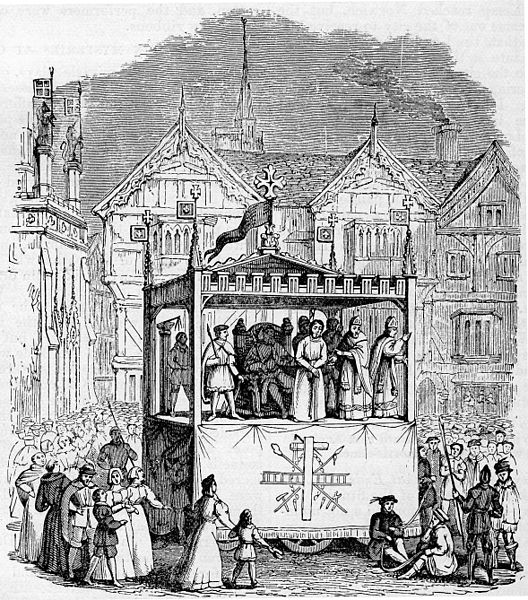
Yesterday, I went down to Chester to see the ancient Mystery Plays, they date back to the 1300s. They're done every five years on the green outside the magnificent Chester Cathedral. Last night was Part Two, basically Gospel thru Rapture, & the actors speak in rhymed couplets which I assume are apapted or descendent from the original. There was about a hundred people in the cast & a hundred in the audience. It had the feel of big-budget community musical theater; it was essentially Jesus the Musical without the angst or subtlety of Jesus Christ Superstar, & MIDI Anglican music. The actor playing Jesus was black, every other cast member was white. He did in fact ride into Jerusalem on a live donkey, who was on stage for only two minutes, but whom I could vaguely smell the whole time. I assume there must be an ancient tradition of having Pilate be less bad than the Jews, who are rarely more than a screaming mob & conniving middle managers, whereas the Romans seem curiously intrigued by Jesus's divinity. The kids in the cast seemed to be having a little too much fun with the "everyone-gets-to-whip-Jesus" scene. Anyway, it was great entertainment, & after the Resurrection, just when you think it's over... there's a half-hour Revelation Song-&-Dance with devils, zombies, smoke, fireworks, flaming swords, god in a wheel-chair, a female clown-antichrist on a spinning cross(!), & fifty chorus members being dragged screaming into hell.

July 02, 2008

The Adventures of Little Moby Dick


I don't think I could summarize the story any better than the back cover. Forgive the awkward translation, but I just didn't want to lose anything.

“The immortal story of Herman Melville about a big white whale is presented anew in a new adventure of little Moby Dick.
“The story begins during the year of 1841, when glorious ships sail the seven seas. But deep in the ocean is another world, in which the shy orphan whale by the name of Moby meets his friends – starfish Stella and sea horse Winnie. The two of them encourage Moby to overcome his fears by showing him their underwater world including some of the strangest sea creatures. But on the surface are many dangers, particularly the ruthless Captain Ahab, who will stop at nothing to catch the biggest miracle in the sea—a white whale. Moby must come face to face with him in order to take his place as lord of the sea. One story, showing the joy of life and the magic of friendship.”

As you can see, The Adventures of Little Moby Dick is another of those post-modern re-tellings of canonical tales re-inventing previously vilified or undeveloped characters such as Wicked, Rosencrantz & Guildenstern Are Dead, and Ahab's Wife. Of course, to say that Moby Dick was previously undeveloped is absurd. And it remains open debate how you can have a post-modern take on an already so thoroughly post-modern novel. However, it does illustrate the depth of Melville's world that it can support such further stories, even ones that contradict the events recounted in The Whale. Of course, we have no idea from Melville whether Moby had starfish and sea horse friends, and in all likelihood, he did. Did Ahab really kill Moby's mother and is this the true source of the enmity between them? The movie brings up more questions than it answers, but I must say that the movie brings the story to a more natural conclusion when Ishmael and Moby become friends and sail the seven seas together.

February 23, 2008

Naked Male Semi-Epic Prologue

This mini-epic poem will be written daily thru March, & e-mailed (in pdf form) to Mr Golden at work, who will illuminate it. A subsidiary of the "important assignments" project, it's an attempt to create something daily - a stanza & an illumination. Hence the strict format: in Five Parts (for five weeks) of Five Stanzas (for five working days.) The three-stanza prologue was the test run, this week. The illuminations may not appear on this website for several months, but I'll keep the blogosphere posted on the progress of the poem. (You can see this picture larger if you click on it. - Note: this is not what the official pdfs look like, standard garamond & bulgarian garamond.)


Prologue.


i.

The naked male was twenty-eight when he died.

The first three years he didn't remember well.

He shocked the blogosphere with a deep-fried suicide,

And fiery demons dragged him thru to hell.

Sing, March & February goddesses!

There's truth & nudity cow-tongues can tell!

There's magic music vibrating from your dresses!

ii.

The Naked Male's father had come down from Illinois,

To see how ordinary folk in Arkansas loved.

Nearing the borders of Blakemore, he saw a boy

About twelve winters worn, with face already rough,

Copulating jovially with a rabbit from the brier.

Further on, he saw an elder reposing, flagellating himself:

When quizzed, the old man sighed, no longer quick to catch a hare.


iii.
There on the threshold of Blakemore, he was raised,

The purest sprouted from the unlikeliest soil,

His rotten father decomposing, fertilizing the chaste.

Hundreds of forgotten siblings lost at the Coney Island Revival,

The pathetic & the awesome, evincing strange pity,

To let our bottoms bare in a heavy cell,

Begin the story, a lesson, his tragedy.

February 02, 2008

the black eyed peas beat James because they got Scarlett Johansson and he didn't


FYI I think the best-streaming version of this is not the youtube, but the original (I think), which is at www.dipdive.com

I wasn't afraid to stand for something...
to stand for "change"...
I wasn't afraid of "fear"...

it was pure inspiration...

so I called my friends...
and they called their friends...
in a matter of 2 days...
We made the song and video...

Usually this process would take months...
a bunch of record company people figuring out strategies and release dates...
interviews...
all that stuff...
but this time i took it in my own hands...
so i called my friends Sarah Pantera, Mike Jurkovac, Fred Goldring, and Jesse Dylan to help make it happen...
and they called their friends..
and we did it together in 48 hours...
and instead of putting it in the hands of profit we put it in the hands of inspiration...

then we put it on the net for the world to feel...

When you are truly inspired..
magic happens...
incredible things happen...
love happens..


-Will.i.am, "Why I recorded Yes We Can", from the Huffington Post.

January 28, 2008

More Quixotic Filmmaking: Terry Gilliam's role in Heath Ledger's Fate

Friends of the Blog - (Hello, there!) - who know of Itwaslost.org's keen interest in the development of the film The Imaginarium of Dr Parnassus, point me to this article from People Magazine, which I will quote below in full. Besides our beloved Terry Gilliam's horrendous luck with certain projects - please see the film Lost in La Mancha (about the death of his Quixote), & all of the documentaries on the Criterion edition of Brazil, & the awful & incorrect reviews for his wonderful Baron Münchhausen, for the full cursed story of his career - he is an intense director, who demands a lot from his actors. Here is the latest about the effort to keep the Imaginarium alive after the death of Heath Ledger:

Director Terry Gilliam is feverishly working to figure out how to keep Heath Ledger alive on film, according to one of the late actor's costars in The Imaginarium of Doctor Parnassus, which Ledger was still shooting when he died last week.

"Terry's throwing himself into the job of trying to salvage the picture," veteran actor Christopher Plummer told PEOPLE over the weekend.

Despite earlier reports that the director might shelve the $30 million production, Gilliam, whom Plummer describes as "terribly saddened" by Ledger’s death is "trying to work out at this moment how to continue on. Fortunately, because the film deals with magic, there is a way, perhaps, of turning Heath into other people and then, using stills and I think they call it CGI…

"Terry was a very good friend [of Heath's]," adds Plummer. "He very wants to go on with the movie, and I can very much understand why. Because he wants to dedicate it to Heath, of course."

Ledger and Plummer both left the London portion of the movie's shoot last weekend and were due to continue filming next week in Vancouver. Leaving England, says Plummer, "Heath was in very high spirits. He was just enjoying himself tremendously. It's a rather fanciful script, and he was wonderful in this role."

Confirming earlier reports that Ledger hadn't been feeling well on set, Plummer says, "we all caught colds because we were shooting outside on horrible, damp nights. But Heath's went on and I don't think he dealt with it immediately with the antibiotics.…I think what he did have was the walking pneumonia."

On top of that, "He was saying all the time, 'dammit, I can't sleep'…and he was taking all these pills [to help him]."

As well as the damp cold and lack of sleep, Plummer describes the shoot as rigorous. "We had to shoot every second we were out there…there was hardly any time to go into the tent or the car to keep warm. We just kept shooting…boom, boom, boom…there was no pause. It was very, very hard work."

Ledger would have appreciated the show-must-go-on mentality, says his co-star. "He was terribly likeable and obviously enormously talented…and the combination was terrific. It's such a shame these things have to happen to the good ones."

As for reports that Gilliam has approached Johnny Depp to step into Ledger's role, the actor's rep tells PEOPLE: "There have been no official talks, and he is currently working on Public Enemies for Michael Mann for Universal."


I love the implication that a combination of Johnny Depp & computer graphics can save any movie, so long as it's about MAGIC. I would prefer to see Gilliam use some of his more signature techniques - old-fashion camera tricks, models, puppets, & animation - to put Ledger's head on Depp's body. Put that in the promo, & they can easily make back their $30 Million.

July 11, 2007

Rhythm of Tonight's Dinner

My wife believes she is being transported to a holocaust of cookery.
Her watercolors are important,
Without them my illuminations are only two-dimensional,
And even though our doctor says she can't,
I know she can make this mutual contribution when she will.
The Sous-Chef beneath our Poet Laureate's refrigerator has been eaten by dust bunnies.
This is a great responsibility for the spaceships of the world, but they've never known hurry.
The radio has been turned off.
My nine Latvian Nannies have been sent home.
There is a strange magic in my daughter's cough.
I detect in my apéritif an undertone of mermaid foam.
And the rising politician next door, whose scandal is flavored with yellow & red curries,
Like tonight's dinner, will be squished neath the weight of ten thousand vicious inquiries.

What happened to the questions of last February's poem? Who invited that wanker?
The health inspector's knocks,
Always punctual & always ill-timed,
Have shaken the staff to the holes of their holy sox.
In strictest verse & meter his report is rhymed.
The administration of the household will look both ways before deciding the vegetarian option.
The Princess of Belarus has arrived without her secret friend to spank her.
I have been struggling to change the subject
Away from the issues plaguing Rwanda's economy,
But my idiot brother has no respect
For what the upper-class doesn't find funny.
And the lovely young heiresses, whose blouses' integrities fragilely depend on a safety pin,
Like tonight's dinner, are already looking to East Asia for a righteous multicultural adoption.

This 1897 Cognac can barely wash away the taste of those peasant dishes.
Has my wife forgotten the reason
I've lost my robes to the hungry wind?
And why we don't serve pitted fruit at the end of the season?
But all my opinions she must naggingly rescind.
My brother & the Princess are still arguing about whether the Solanum Nightshade was genetically modified,
While the Gringo slaves of minimum wage are buried beneath piles of dirty wishes.
Putting my feet up on my great-great-grandmother's ottoman,
I can reflect upon a couple well-phrased biblical verses.
There are a few hostile mergers which I ought to plan,
But right now I'm content to let the demitasse scream its curses.
And the taxidermied venison heads, near the ceiling, noble & sad-eyed,
Like tonight's dinner, have been taken from the wild & irreverently deep-fried.


March 11, 2007

Photos: Fallen Leaf Lake & Desolation Wilderness, Fall 2004

These are photos from my first season working at the Stanford Sierra Conference Center, on Fallen Leaf Lake, which is just South of Lake Tahoe in California. Click on the image to see it larger.


“Dear old man,” she said, softening down, & a little shifting the subject, “when you think of that old kinsmen of yours, you know there must be a secret closet in this chimney.”

“Secret ash-hole, wife, why don’t you have it? Yes, I dare say there is a secret ash-hole in the chimney; for where do all the ashes go to that we drop down the queer hole yonder?”

“I know where they go to; I’ve been there almost as many times as the cat.”

“What devil, wife, prompted you to crawl into the ash-hole! Don’t you know that St Dunston’s devil emerged from the ash-hole? You will get your death one these days, exploring all about as you do. But supposing there be a secret closet, what then?”

“What, then? why what should be in a secret closet but – ”

“Dry bones, wife,” broke in I with a puff, while the sociable old chimney broke in with another.

-Herman Melville, “I and my Chimney” (1856)


Infinite sad mischief has resulted from the profane bursting open of secret recesses.

-Herman Melville, “I and my Chimney” (1856)


A man walks into a bar, & half of his head is an orange.

The bartender says: “If you don’t mind me asking, why is half of your head an orange?”

The man replies: “Well, it’s a funny story. I was in a mysterious cave in Turkmenistan, & I found a lamp, & when I rubbed it a magic genie came out & gave me three wishes. For my first wish, I asked that my wallet would always be full of money, so no matter where I was, & opened it, there’d be more bills in it.”

The bartender said: “Gee, that’s a pretty smart wish.”

The man says, “Yeah. For my second wish, I asked that no matter where I passed out, no matter how drunk or wasted I was, when I woke up, I would be in my own bed with no hangover.”

The bartender said: “Wow, that’s a really great wish. What was your third wish?”

The man says, “For my third wish, I asked that half of my head would be an orange.”

-Joke told to me by Miss Jennie Jo Lee.


March 04, 2007

Music Review: A Flowering Tree, by John Adams

Last Friday Night, I was less than ten feet from John Adams’s butt as he conducted the American premiere of his new opera, A Flowering Tree, with the San Francisco Symphony in Davies Hall. I had bought the tickets months ago, & was psyched about my second row seats, but when we arrived for the pre-concert talk, I realized they were way to the left side. The way the stage was set up, the orchestra was on the left, & the percussion & platforms for the singers & Javanese dancers was on the right – so that far forward, we would only be able to see three violinists & the conductor! So right as the lights dimmed, we moved front & center. It was intense being that close to the composer conducting his own work, not to mention the opera singers, who can be deafening at that proximity. As for nearness – relative in its importance depending on the level of celebrity one is near – I was once closer to Mr Adams, as he walked down the aisle before Dr Atomic in 2005. My friend Mrs Bonnie Anne Whiting Smith was once physical shook by the shoulders by John Adams, something approaching annunciation for her. At Oberlin Conservatory, she had told him that she played the difficult drum part for his Chamber Symphony, &, apparently moved by so infamously tricky a multi-percussion part being conquered by such a petite young redhead, rapturously embraced & moved her. I believe, so I’m told, she was osmosisally impregnated with triplets.

A Flowering Tree was beautiful, a welcome relief after the abstract density of Dr Atomic, & his Pulitzer Prize-winning 9-11 piece, On the Transmigration of Souls, both of which seemed to be moving in the dark direction of some of Krzysztof Penderecki’s “Sound Mass”-style compositions of the ’60s. If you don’t know what that means, read: huge, dissonant movements of sound. Adams’s music of the 1980s always had a pulse, & his orchestration has gotten denser with thick, Stravinsky-esque textures & difficult asymmetrical rhythms. However, the groove & lushness of the texture made his sound very approachable & fun. Somehow, in the past decade, he’s completely lost his groove (except in some amazing clearings, like one prophetic aria in El Niño, “And I will shake the heavens….”). So this density of atmospheric texture became more & more what the music was about, & some of us were sad about that. Don’t get me wrong, when it is modal & beautiful, like the Love Duet in Dr Atomic or the guitar solo in Naïve & Sentimental Music, it's almost transcendent.

Alex Ross, in the New Yorker last November, writing about the Vienna premiere, declared that A Flowering Tree was “unlike anything that the fifty-nine-year-old composer has written”. He, & many other critics, have seen it primarily as a response or palinode to Dr Atomic, & wasted time comparing them. (It was written in less than a year immediately following the premiere of Dr Atomic.) I think it sounded a lot like El Niño, his nativity oratorio from 2000, & I view the music as an expansion on many of the ideas he developed there. His vocal melodies this decade are blander & less direct than his 1980s’ operas, but they all share a certain shape & style. The orchestration for A Flowering Tree was incredible from beginning to end, the whole thing just sparkled.

I’ll let Alex Ross describe the plot:

A Flowering Tree, for its part, takes off from The Magic Flute. In both operas, the love of a prince and a maiden endures after a long separation and painful trials. There is also a kinship with Richard Strauss’s autumnal masterpiece “Daphne,” based on the ancient Greek myth of arboreal metamorphosis. But, where Daphne’s transformation is permanent, Kumudha, in the Indian tale, can move in and out of her tree shape when pitchers of water are poured on her body. The Prince falls in love with her and marries her. The trials begin when the Prince’s sister exploits the magic for public show and neglectfully leaves Kumudha trapped in a grotesque hybrid state, whereupon she crawls away from her husband in shame. Only when the Prince recognizes her voice in a travelling band of minstrels is she restored to humanity.

The environmental themes are there without his having to muck with the text or spell anything out. I see Kumudha as a representation of our interconnectedness with Nature, even especially trees – we understand that better now than when the fairy tale was written, but we feel it less. When the Prince’s sister exploits her & mutilates her, it defiles both the human & the arboreal, & there is somehow a direct connection to that mutilation & the poverty & misery immediately following. Exploiting nature leads to the debasement of humanity, which leads to the Prince’s despair & consequent asceticism.

Here’s what John Adams wrote about it in the Guardian:

The libretto is written in English and Spanish. I knew that the chorus in the first performance would be the remarkable Schola Cantorum of Caracas, and I wanted them to sing in their native tongue. Using two languages is also a reaffirmation of my feeling that we are living in a time of global cultural awareness, with all its pain and wonder. In the US, there is a panic response to immigration that has recently expressed itself in "English-only" ballot initiatives. I suppose my pleasure in writing a polyglot libretto is a means of reaffirming my feeling that the best culture is the one with the richest variety of sources. And, of course, Spanish is a terrific language for singing.

[…]

My previous opera, Doctor Atomic, first performed in San Francisco in October last year, is about the most threatening matter in our contemporary lives - man's new-found ability to destroy not only himself but his natural environment. One can think of the atomic bomb not only as an immensely destructive weapon, but also as a metaphor for the power to corrupt our "nest", Earth. In the opera, there is a disconnection between feminine and masculine types of energy. The atomic scientists, all male, are absorbed in their invention, caught up in a race to build the weapon. I do not criticise what they did, because it was wartime and they began their work in the belief that they were saving civilisation from the threat of Hitler. But we see the invention take on a sinister life of its own, and even Robert Oppenheimer, the director of the project, becomes aware that the weapon will eventually threaten all human life. The women in Doctor Atomic are in a powerless situation, but they have a moral consciousness, able to see into the future, like Cassandras.

In A Flowering Tree, the male/female relationships begin as traditional class and gender inequality - a rich prince dominating a poor peasant girl - but what follows is a story of self-discovery and humility that resolves in an image of wholeness and love. And I loved the fact that, after three years of working on an opera about plutonium and high-energy physics, the most advanced technology in my new opera is an elephant.

I don’t read in that that John Adams is becoming a Luddite: he uses technology to compose, & electro-acoustically in performance. What I’ve always loved about his music is that breadth of assimilation. He lets himself be inspired by the whole gamut of Classical Music from Mozart thru Schoenberg & Glass, along with world & popular musics. The result is a kind of twenty-first-century Americana – not in a postmodern way, with its leveling of hierarchies, but in the cultured multi-culturalism felt on the streets of the San Francisco Bay Area.

My biggest complaint is Peter Sellars, the opera director & Adams’s collaborator for twenty-five years. He likes to keep the stage busy with dancers & baroque accouterments, as if our attention spans have been reduced to the pithiness of the so-called MTV-generation. Also the self-conscious multi-culturalism which subtly blends in the music, Sellars thinks he can cheesily glorify on stage, with Javanese dancers & the like. I loved those dancers, but something about it didn’t mesh. The constant movement was distracting. I think it’s just time for Adams to move on from Sellars, whose innovation may have peaked in the ’80s. And my god he was schmaltzy in the pre-concert talk.

February 20, 2007

Rhythm of the Bard's Dilemma

Shall I recede into a dead white literary annihilation?

The revolutionary sings

Out to a crowd of equal-minded pawns

About the hubric cruelty of kings,

But the dumpster’s heard it all before & yawns.

Who is the poet of this war? Where is the pacifist’s magnanimity?

Who will glorify the worm-feeding warrior? Where is the imagination’s salvation?

The spirit of joy! I am conceived in an instant!

In nine months I’ll be too old

To be drafted, & these magic eyes must squint

At a sun-load of stories too yellow to behold.

And the boys who prove the bitterness of victory,

Like their bard, will disappear into infinity.


In Japanese comic books I find all my answers.

Thru the gross perverted doodlings

And the incoherencies of plot & character

There is a poet’s lust for truthy things,

The stars & spheres ecstatically concur.

Those non-violent souls in stoned dreadlocks scream & articulate & scream!

Flags on bombs on graffiti on concrete, & naked machine-gun dancers.

And in an ancient epic style I pray

To Santa Claus & the I-Ching & the Nixon Dollar

That we’ll all sit at the same table one day

With the Saint & the Soldier & the Tax-collector & the Scholar.

And the girls who weep for the girls in the frontlines, in new professions extreme,

Like their bard, will resound across the hills of an ecchoing dream.


Where are the novelists who use sesquipedalians & discuss their own art in their books?

The pundit leans over during the commercial

And asks the show’s host if sooner or later

Their roles will spin in a festive reversal,

But neither will ever blip on my galactic radar.

Where is the Theater of the Judges? Where on this spec is heaven’s edge?

Am I our nation’s final poet of the divine? What use are prophets or ministers or crooks?

And with four simple rhymes I write

A love song for violence & lost ambition.

It will be read loudly at the beginning of night

Accompanied by sixteen musicians & quiet submission.

And the elders who created this whole rapturous mess will pledge,

Like their bard, not to jump like fools off a completely avoidable ledge.


February 02, 2007

Letter to the Nations of the Earth

Stop barking at the impressive few! Stop holding hands with princesses!

If apples immunize you from doctorates of theology,

Whence comes our American mythology?

Our ears are bended upwards towards the silent hurricanoes!

On the distant horizon I see a staggering stentorian bucket of wishes!

But I've forgotten the appropriate terminology,

And she lost hers studying visionary mycology.

Can you rhyme with the goddesses? Can you appreciate Pluto's distant credibility?


The shaman is kneeling before our ancient trance, a silhouette.

And apples & bananas & oranges grow carcinogenically

From this barren desert dirt, nourishing, organically.

I am in Nevada! Our Lady of the Deep Mountain Lake is lost in annunciation,

I am in the Western Zephyr! At least I glanced the graces chasing her magic shadow.

And railways remember to comply fiscally

With demands of the land & its fecund buoyancy.

But whence comes our American Symphonies? Where's our newest cultural mecca?


Like in Mauritius, the rats & pigs ate the last Giant Turtle egg.

Like in the hills of New Zealand, they had to relocate that inflatable parrot.

Like in Canada, men with puppets & cycle-planes are rehabilitating whooping crane chicks.

Like a pot of golden toads in Central America that has been boiled & evaporated.

And like the reefs - O my God, I can't go on.

O bless the corral & may its descendants bear fruit perceived by the voyager,

Forever & ever. Amen.


Start singing the blues of futurity! Start reversing the rapture, pending an antepenultimate postponement!

If apples are the first cessation in a chain

Of metempsychosis, ending with the resurrection of Cain...

But no! The verses will grow longer! Longer than the queues of transcendental poetry at the market!

Off the page she'll blow you furiously! Down the circular library thru the craters below the Earth!

But I've forgotten where the escalator takes the rain,

And we'll finally be done with these damn'd biblical allusions, the pain.

Can you dance with harps on your loins! O can you understand these made-up words!

September 06, 2006

Two Prophetic Poems, & two ideas

The Poet for J.K.

His genius is sired of misery or magic;
he dwells between disaster & the dream.
He might have been sedate; but only tragic
ecstasy is musical to him.
In every chaos he will wish a cure;
in life, a higher mystery of sorrow;
in death, the last existence that is pure.
Curoisity betrays him to tomorrow.
Necromantic passion, final terror
is his bequest: The wound was all he had
to multiply. Balancing the rope of error,
he shall fall to doom. He shall be mad,
sadly, deceived, he shall live, and he shall die
a master of all mummery.

-Allen Ginsberg

This poem was published in the September 4th issue of The New Yorker. Because of the title, I invite the blogosphere to read it not as a poem written in 1949 to Kerouac, but as a prophecy to J.K. Rowling. Indeed, there are certain undeniable "coincidences;" as Hermione pointed out, now that we know some real prophecies do exist. The poem alludes directly to Harry's "hero complex", a sort of artistic necessity for "tragic ecstacy" instead of a "sedate" life. And, of course, his attraction to situations that lead to death and sorrow - the Rowling books conclude that one is fated only because one chooses to be fated. Dumbledore has always preached trust, love, and friendship; and we await Book Seven to know if we can believe in that morality. Harry, like Hamlet, is trapped between two revenge tools: love/friendship or individualism/violence. He begins life an orphan with only a scar - "The wound was all he had to multiply" could mean opting for the bad timing of Hamlet, resulting in his own untimely end. He is "the boy who lived", but Ginsberg tells us what to expect: "He shall be mad, sadly, deceived, he shall live, and he shall die a master of all mummery." And even Rowling has been setting us up for a tragic ending (she recently said in an interview: "I can completely understand, however, the mentality of an author who thinks: 'Well, I'm going to kill them off because that means there can be no non-author-written sequels … so it will end with me, and after I'm dead and gone they won't be able to bring back the character.'") However, like Christ & Kerouac, she is a master at setting up great surprises. What does it mean to "die a master of all mummery"?

____________________________________________________________________

On the first floor of the San Francisco Museum of Modern Art, there is a 1951 oil on canvas by Robert Rauschenberg called "White Painting (Three Panel)". It is a triptych of evenly spaced, pure white paint on large white fabric. Yesterday, looking for my lost friends, I waited in the room with this painting for several minutes, & was entertained by the various reactions. Two artsy teenage girls acted like it was the most inspiring thing they had ever seen, but walked away after barely looking at it. Then, an elderly British couple enterd the room. She rolled her eyes & pointed at it sarcastically. He droned "ohh dear..." laconically, hilariously. I'm not suggesting that there is a proper response to this painting. But the "ohh dear" is interesting, as the painting is fifty-five years old, & should hardly be a cause of concern. Rauschenberg, of course, had a long, varied career, brimming with talent & creativity; so the painting can not be accused of being a fraud by a hack. He invited, in the notes, the viewer to look at his own shadows. The advantage of Cage's 4'33", a composition of silence, is that it mandates a duration. All manner of auxilary noises fill up the empty space (especially in New York, where both Cage & Rauschenberg worked.) What is it about empty canvasses that so offend audiences, especially when the emptiness they perceive can never exist?

____________________________________________________________________


Prophecy for an antepenultimate doom.

My friend, take heed lest any one deceive all,
There shall be wars & rumors of corruption,
But these are not the ultimate destruction,
Nor are these evils unredeemable.

When all from Earth are obliterated & erased,
There shall be none to speak of it or hear it,
And no responsibility & none to bear it,
The legacies of ants will be effaced.

Woe to them who go down to Brazil for help!
You better free your mind instead, you should
Learn the famines of the land where your ancestors stood,
And you should listen to the yelps of every bitch's whelp.

So go & set a watchman for the fallout,
And design a better Industrial Revolution,
Go study the natural cycles for a solution,
And leave the praying to the more devout.

July 02, 2006

Music Review: 10 Suggestions for Summer Listening! Part I

Here I present five of ten albums in various genres, hand-picked from the very favorites of my music collection. Some of the hyperlinks are audio samples, powered by Amazon.com.

CLASSICAL

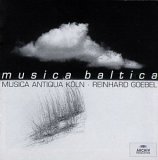
Musica Antiqua Köln (directed by Reinhard Goebel) – Musica Baltica (1999)

This could become an essential album to anyone whose music collection lacks obscure composers of the Baltic Mid-Baroque (late 17th Century). It is also, hands down, the finest early music violin playing I have ever encountered, led by savant-genius Reinhard Goebel. He guides his ensemble thru the frolicsome flares necessary to any well-researched project of period-instrument Baroque performance, but one never feels bogged down in the mordents. He has also introduced me to some of the most haunting & unusual music. It is a long album, but don’t miss the final tracks, with two by Johann Valentin Meder, the controversial Danzig Kapellmeister. The Sonata di Battaglia begins with triumphant C-major chord which saws away for a solid two minutes before changing! Also, the regal trumpets & bassoons on Vincenzo Albrici’s Sonata a 5 continue to move me, after years of repeated listenings, to minuetting around the room.

_________________________________________________________________________________


Dawn Upshaw – Osvaldo Golijov: Ayre, Luciano Berio: Folk Songs (2005)

Stand up for the Crossover disc of the decade! The pairing of Berio's 1960's take on combining world folk genres with contemporary classical innovations, with Golijov's 21st Century attempt, leaves a lot to think about. Golijov is the Jewish-Argentinian-American who did all of those amazing, yet popularly denounced, arrangements for Kronos Quartet's Caravan (gypsy) & Nuevo (latin) crossover experiments. (Kronos fan-purists would prefer them to keep with the heady academic program, but really they're just keeping up with more realistic trends & innovations - their newest album is all from Bollywood soundtracks.) Golijov's own music, for instance in Ayre, has a ton of integrity whilst dipping into every imaginative world idiom. Clearly, if the 21st century offers any direction, it's welcoming inspiration from the sheer bulk of recorded music available, & relishing in its ability to be blended in the genre of notated concert music. Berio's Folk Songs have been recorded dozens of times, but this ensemble is especially tight, & the piece has really worn well during its transition from contemporary classic to over-preformed classic-proper. Dawn Upshaw, I think, is one of the most amazing vocalists alive. She can keep her day job at the conservative Metropolitan Opera while preforming the classiest new music & anything else she wants to: Weill, Bernstein, Ives, Berg, Adams, Purcell, Stravinsky, &c. Her voice is really just an instrument of her intelligence, tastely borrowing slides from jazz, an occasional hugeness from Wagner, & deepening it with her own gravity or lightening it with her wit. Golijov's music allows her to showcase a new breadth, replete with sufi trills, or whatever the music calls for. As for Berio, "I wonder as I wander" has never sounded so beautiful.

_________________________________________________________________________________


Kevin Volans - White Man Sleeps (1990)

1980s British Minimalism is one of the sadly neglected genres of 20th Century Music. Graham Fitkin, for instance, perhaps suffers from a contemporary embarrasment for cheezy synthesizers. His seminal Cud (1988) perhaps sounds a bit too much like The Muppets Take Manhatten. Many recordings by Fitkin have not been reissued - (Look for Argos CDs in used record stores!) Volans, however is the opposite in aestetic - his music is extremely earthy. A white South African native who moved to Dublin, several of the pieces on this album are for two harpsichords tuned liked African thumb pianos (a compositional risk, I assume, severely limiting performance possibilities). Kronos Quartet has recorded the string quartet version of White Man Sleeps, an arrangement of the version on this album for two harpsichords, viola da gamba, & percussion. The Smith Quartet preformance on this album, I cannot emphasize enough, rocks so much harder than Kronos. Really, man, this is some of my favorite music. Like Steve Reich, it clearly links '70s-'80s Minimalist form to traditional African counterpoint, written for early Western instruments, & performed with a lot of heart.

______________________________________________________________________________


Steve Reich - You Are (Variations) (2005)

I am curious how Reich-virgins might approach this music, because, more than ever, he is building on a career's-worth of innovations. It has the form of Tehillim - (two two-part movements, lots of soprano-cannon-lines sung in hebrew, third movement slow). It has the thick piano writing of several earlier pieces, but his dissonence has deepened, like in Four Quartets. It has similar repetitive-philisophical-text-setting as The Desert Music & Proverb. Melodically, the second movement of You Are starts with a jumpy-hebraic melody reminiscient of Tehillim, which gets dissected in a way similar to The Desert Music, so that the words are slowed down into luscious chords, amidst thick pulsing pianos & percussion. I feel that Reich has yet to really disapoint, nor are developments of previous ideas ever boring (or, like Glass, pathetic.) This piece, despite borrowing from an entire career, feels fresh, original, & even a tad rebelious. His mystic-contemplative side is as deep as ever, his harmonies as luscious - everything - his pace, ochestration, drama, everything that makes music good, is of the finest quality. I guess one should consider this an excellent piece of music grown from a carefully developed style, which has evolved over four decades. Also, on the same album, is Maya Beiser's performance of his latest Counterpoint, Cello Counterpoint, a series of pieces where one instrumentalist plays on top of herself twelve-or-so times. This has by far the fastest changing structure & some of the richest harmonies of any of them. It's beautiful, recorded with gorgeous production.

_____________________________________________________________________________


ROCK / COUNTRY

Emmylou Harris - Wrecking Ball (1995)

In September, we'll be celebrating the 11th anniversary of this seminal album. What links it to 90's country music, or 90's rock? I don't know. It sounds more to me like someone has stuck this album in a future capsule from 2050, where Emmylou's plastic head has been preserved in a laboratory. Her voice is both alien & earthy. It aches as Jesus must have, yanked between two universes. The lyrics of the songs she chooses to sing are like a snow plant, organic but a seeming stranger - "And if you were Willie Moore / And I was Barbara Allen / Or Fair Ellen all sad at the cabin door /A-weepin' and a-pinin', for love / A-weepin' and a-pinin', for love." It's really the production that makes this music so special, tho. Daniel Lanois, who has also worked with Bob Dylan, U2, & Peter Gabriel, matches Harris' alien-earthy dichotomy with his own magic. What is the "wrecking ball"? Is it what happened to the rolling stone? A symbol for one generation, which began as aimless, & ended somewhat heartless & destructive? Neil Young sings back-up on his own song, "meet me at the wrecking ball / I'll wear something pretty & white / & we'll go out dancing tonight." Every song carries a subtle mystical overtone, subtle even when she's singing directly to her "savior". Her version of Gillian Welch's "Orphan Girl" is my favorite of this oft-covered song. (I sing it with a ukulele). &, of course, "All My Tears" is one of the most beautiful things ever recorded.