Showing posts with label Moby-Dick. Show all posts

October 03, 2009

About the new Emoji Dick (Melville's Moby Dick; or, The Whale, told in Emoticon Images)

At least the creator of Emoji Dick has noble intentions:


I’m interested in the phenomenon of how our language, communications, and culture are influenced by digital technology. Emoji are either a low point or a high point in that story, so I felt I could confront a lot of our shared anxieties about the future of human expression (see: Twitter or text messages) by forcing a great work of literature through such a strange new filter.

First, I needed a public domain book that I could get the plain-text version of easily. The Bible seemed too obvious. I then wanted something very large and long, so that I could demonstrate the scale possible with Amazon’s Mechanical Turk. Moby-Dick seemed to fit those criteria, so I just went for it, and assigned the first couple chapters as a test run. The results were fantastic. I then realized that the story behind Moby-Dick is about this huge, seemingly insurmountable challenge, told using metaphors and stylized language, and in a way, that’s what translating a book into emoji is—a weird, huge challenge told in metaphors and stylized language.


--From The New Yorker's Book Bench Blog interview with Eyebeam's Fred Benenson

August 17, 2009

This huge ambergris that she found on the beach fifty years ago...


Pele's new twitter name is anbargris, & I recalled this picture of a humongous piece of ambergris that an old lady found on the beach in New York. From the Times in December 2006:

In this season of strange presents from relatives, Dorothy Ferreira got a doozy the other day from her 82-year-old sister in Waterloo, Iowa. It was ugly. It weighed four pounds. There was no receipt in the box.

Inside she found what looked like a gnarled, funky candle but could actually be a huge hunk of petrified whale vomit worth as much as $18,000.

“I called my sister and asked her, ‘What the heck did you send me?’ ” recalled Ms. Ferreira, 67, who has lived here on the eastern tip of Long Island since 1982. “She said: ‘I don’t know, but I found it on the beach in Montauk 50 years ago and just kept it around. You’re the one who lives by the ocean; ask someone out there what it is.’ ”

-"Please Let It Be Whale Vomit, Not Just Sea Junk", by Corey Kilgannon, New York Times, December 18th, 2006

The chapter on ambergris in Herman Melville's Moby Dick; or, The Whale is here.
Who would think, then, that such fine ladies and gentlemen should regale themselves with an essence found in the inglorious bowels of a sick whale! Yet so it is. By some, ambergris is supposed to be the cause, and by others the effect, of the dyspepsia in the whale. How to cure such a dyspepsia it were hard to say, unless by administering three or four boat loads of Brandreth's pills, and then running out of harm's way, as laborers do in blasting rocks. [...]

Now that the incorruption of this most fragrant ambergris should be found in the heart of such decay; is this nothing? Bethink thee of that saying of St. Paul in Corinthians, about corruption and incorruption; how that we are sown in dishonour, but raised in glory. And likewise call to mind that saying of Paracelsus about what it is that maketh the best musk. Also forget not the strange fact that of all things of ill-savor, Cologne-water, in its rudimental manufacturing stages, is the worst.

July 02, 2008

The Adventures of Little Moby Dick


I don't think I could summarize the story any better than the back cover. Forgive the awkward translation, but I just didn't want to lose anything.

“The immortal story of Herman Melville about a big white whale is presented anew in a new adventure of little Moby Dick.
“The story begins during the year of 1841, when glorious ships sail the seven seas. But deep in the ocean is another world, in which the shy orphan whale by the name of Moby meets his friends – starfish Stella and sea horse Winnie. The two of them encourage Moby to overcome his fears by showing him their underwater world including some of the strangest sea creatures. But on the surface are many dangers, particularly the ruthless Captain Ahab, who will stop at nothing to catch the biggest miracle in the sea—a white whale. Moby must come face to face with him in order to take his place as lord of the sea. One story, showing the joy of life and the magic of friendship.”

As you can see, The Adventures of Little Moby Dick is another of those post-modern re-tellings of canonical tales re-inventing previously vilified or undeveloped characters such as Wicked, Rosencrantz & Guildenstern Are Dead, and Ahab's Wife. Of course, to say that Moby Dick was previously undeveloped is absurd. And it remains open debate how you can have a post-modern take on an already so thoroughly post-modern novel. However, it does illustrate the depth of Melville's world that it can support such further stories, even ones that contradict the events recounted in The Whale. Of course, we have no idea from Melville whether Moby had starfish and sea horse friends, and in all likelihood, he did. Did Ahab really kill Moby's mother and is this the true source of the enmity between them? The movie brings up more questions than it answers, but I must say that the movie brings the story to a more natural conclusion when Ishmael and Moby become friends and sail the seven seas together.

November 09, 2007

Or, he couldn't hear me over the music


In anthropocentric society, a harsh judgment is given to those that destroy or seek to destroy the creations of humanity. Monkey-wrench a bulldozer and they will call you a vandal. Spike a tree and they will call you a terrorist. Liberate a coyote from a trap and they will call you a thief. Yet if a human destroys the wonders of creation, the beauty of the natural world, then anthropocentric society calls such people loggers, miners, developers, engineers, and businessmen.

-Paul Watson, founder of the Sea Shepherd Conservation Society,
as quoted in "Neptune's Navy", by Raffi Khatchadourian,
The New Yorker, Nov. 5, 2007

One bright morning in the middle of the night,

Two dead boys got up to fight,

Back to back they faced each other,

Drew their swords & shot each other

A deaf policeman heard the noise,

And came to claim the two dead boys,

If you don't believe this lie is true,

Ask the blind man, he saw it too.


-American nonsense rhyme, dating back at least fifty years. Several hundred variants are recorded in the U.C. Berkeley folklore archives. This one is recorded by Sarah Clifford, who adds a note reasoning that perhaps the “two dead boys” are Truman & Stalin, & the whole nonsense logic follows that of the “cold war,” which waged in the middle of the night long after they died. By that thought, could the “deaf policeman” be indicative of Reagan?
Update: There's a nice personal essay about this poem on this man's blog.


________________________________________________


Date: Tue, 6 Nov 2007 21:18:08 -0800
From:"James Eliot Quill" <____________@gmail.com>
To:"James Henry Welsch" <_@itwaslost.org>
Subject: An incomprehensible metaphor


Midway through Haruki Murakami's novel The Wind-Up Bird Chronicle, I came upon a chapter entitled "The Zoo Attack (or, A Clumsy Massacre)." Perhaps it should be noted that no other chapter title (so far) has been formatted this way. The second paragraph describes an American submarine surfacing in some detail, and concludes that "although in form and shape the thing before her could have been nothing but a submarine, it looked instead like some kind of symbolic sign—or an incomprehensible metaphor." So, yes, Moby Dick (or, the Whale). The great American epic makes a guest appearance in a modern Japanese epic (I don't know enough to make particularly grandiose or well-informed statements here), which you can take as far as your ability to take yourself seriously will allow you to.


The reason I started re-reading The Wind-Up Bird Chronicle was my discovery of a Portland post-modern book club. Of course, the book had already been finished and discussed by the members of the club. It seemed important that I email Billy Callis (the founder) to find out if the Moby Dick reference had been brought up.


I had no time to write this email, however, because I was, at the moment, on my way to see the San Francisco alt-country (maybe) band Or, The Whale. Maybe now you are thinking that I am obsessed with Moby Dick and these coincidences are entirely my fault. You are correct. At the show, I ran into Billy, to whom I hastily attempted to explain how crazy it was that he was at this particular show at this particular time when I was just about to write to him about what I'd noticed. It went something like this:


"Billy, I was just going to write to you about the chapter in TWUBC where he describes a submarine that's a metaphor that has to be Moby Dick and now here you are at the Or, the Whale show. Isn't that completely insane?"


Billy seemed unimpressed. I theorize that when you read enough post-modern fiction, these nerdy confluences of events become the norm. Or, he couldn't hear me over the music. Regardless, I think it's kind of crazy.

_______________________________________________________

Date: Mon, 5 Nov 2007 20:05:48 -0800
From:"James Eliot Quill" <__________@gmail.com>
To:"James Henry Welsch" <_@itwaslost.org>
Subject: Re: Wartime symphony

Whoa.

On 11/1/07, James Welsch <_@itwaslost.org> wrote:

[Dmitri Shostakovich's Seventh Symphony] the Leningrad had its premiere in Kuybyshev in March 1942. It then made its way around the world, its progress complicated by wartime. As The New Yorker reported in a Talk of the Town item, the score was transferred to microfilm, put in a tin can, flown to Tehran, driven by car to Cairo, flown to South America, & finally flown to New York. Toscanini beat out Koussevitsky & Stokowski for the rights to conduct the Western premiere, which took place on July 19, 1942. Time magazine put Shostakovich on the cover, in his firefighting regalia, with the caption "Amid bombs bursting in Leningrad he heard the chords of victory." The composer became a propaganda symbol for the Allied cause, a profile in courage.

Besieged Leningrad heard the symphony on August 9, 1942, under the most dramatic of circumstances imaginable. The score was flown in by military aircraft in June, & a severely depleted Leningrad Radio Orchestra began learning it. After a mere fifteen musicians showed up for the initial rehearsal, the commanding general ordered all competent musicians to report from the front lines. The players would break from the rehearsals to return to their duties, which sometimes included the digging of mass graves for the victims of the siege. Three members of the orchestra died of starvation before the premiere took place. The opposing German general heard about the performance in advance & planned to disrupt it, but the Soviets preempted him by launching a bombardment of German positions - Operation Squall, it was called. An array of loudspeakers then broadcast the Leningrad into the silence of no-man's-land. Never in history had a musical composition entered the thick of battle in quite this way: the symphony become a tactical strike against German morale.

-Alex Ross, The Rest Is Noise: Listening to the Twentieth Century (2007), pg. 246

__________________________________________________________

Date: Wed, 7 Nov 2007 01:08:56 -0800 (PST)
From:"James Henry Welsch" <_@itwaslost.org>
Subject: re: re: re: re: puppies re: liege
To:Send an Instant Message "Jenny Ruth Crawford" <_________@yahoo.com>

Jenny Ruth,


I spoke to Shaun on the phone today. We discussed this dog issue. I offered to take it, but there are several considerations. 1) I'll probably go up to Tahoe for thanksgiving, & if I go with George, I probably can't take a dog. 2) maybe either you'll come to tahoe so we could take her in your car, 3) if you stayed here for thanksgiving you just watch the dog here, 4) dogs are beautiful & fun, 5) Shaun is camping this weekend & might stay here early next week, 6) James Quill says he's coming on the 14th, 7) I did okay on the GREs, 8) Where are you?, 9) I have the soundtrack to the Darjeeling movie, 10) I hung out with three brits tonight, 11) I fried chantarelles & clams in butter again tonight, 12) I wish we owned a dog, 13) what are you doing for thanksgiving?, 14) I took a test so now I'm drinking beer again after not drinking only a few beers for the last week, 15) Lee & Eric departed from my parent's & are now in Sacramento with the bus, so I reckon they'll reappear here again if only briefly soon, 16) [...] & the number sixteen.


James Welsch

March 20, 2007

Introducing: Doggerel Poetry!

Miss Jenny Ruth Crawford called me at work yesterday & asked what helicopters are doing when you see them flying around. There are many new things to me, living in a quasi-densely populated area like the East Bay. When you see a helicopter, what is it doing? Who's in it? What are they doing? Where do they come from & where are they going? For that matter, how the hell do they work?

If you've ever read the poetry I publish here, you'll notice I am a sucker for difficult themes, & I fall easy victim to the high-art Modernist pretensions of the 20th Century, that many current poets are desperate to move beyond. Of course, many of the poets that the ivory towers dote upon were beloved by a large population - as someone somewhere recently pointed out, Tennyson's birthday was celebrated by the whole country when he was alive. I remember Philip Glass mentioning that Verdi's operas sold out, a bit defensively when he was speaking about how he (Philip Glass) sometimes plays to packed audiences, defensively because of a prevailing 20th Century Academic Zeitgeist that good art can only appeal to a small educated crowd. I guess the lesson I've learned from trying to gage the relation between popularity & its 'esteem' (for lack of a better word... but I mean 'greatness as perceived by a bunch of people who know greatness') is that it's often coincidental, or largely dependent on marketing. Blake's prophecies & Moby-Dick had to wait for upwards of a century before emerging from obscurity. Of course, they're difficult texts for any average reader. But so are things like Wordsworth's Prelude or "The Love Song of J. Alfred Prufrock", but those were soon devoured by huge masses & remain favorites.

That paragraph was tangential. I just wanted to inaugurate some Doggerel Poetry on this weblog, to compliment the tougher stuff. Didn't, in happier times, there used to be doggerel poets at the corner pub, the doggerel poet just one of a usual cast of characters one knew in the community. Those were the days before cars ripped up our society, but now we write doggerel poetry on the internet. And it gets e-mail-forwarded from California to your friends working desk jobs in Chicago. (Click on the little mail button at the bottom of this post.) And hip-hop now fills part of that human need. But what about drunk old white guys? Doesn't anyone want to contribute some doggerel poetry to www.itwaslost.org? James? Sam? Sarah? How about:

What are helicopters doing when they fly above?
Is it for money or is it for love?
Do you need a reason or do you just go?
Won't you take me for a ride up above San Francisco?

Would a helicopter swarm cause the people to alarm?
Is your fuel from Saudi or is it from a corn farm?
If I used one to commute, would I get to work early?
Won't you take me for a ride up above Berkeley?

February 09, 2007

Party Reminder

There'll be a dual birthday party at my beautiful Webb Block Apartment tomorrow night, for Alaine Ball & Jenny Crawford. Terrified that no one will come (which is still likely), we started frantically inviting people. There was also a bit of argument about what the theme would be. I had thought the theme would simply be "green", so I had already told someone... It turns out that was a joke. So we started informing each invited guest of a different theme - a party approach I recommend. Ours might not succeed tomorrow, but hopefully there'll be at least one person dressed outrageously out-of-place.

Here were some of the themes:
-Green
-Cupcakes & Lipstick
-Disney Princess
-Character from Moby-Dick
-No Wave
-Indigenous peoples of the Southern Hemisphere
-The Ottoman Empire
-KGB

January 08, 2007

Mr Quill, Mr Southworth, & Ms Murphy inside the Boston Globe, pretending an indifference to Melville's tomb.

Three of my bosom friends were quoted in the paper at an event at which many of us have previously made appearances, often for the full duration. Mr. Quill claims he was "misrepresented." (obviously, he may have been among the truest enthusiasts there - unless you read his famous tone into the quote.)

Ahab's apostles

Reeled in by the writing in 'Moby-Dick,' devoted fans give a whale of a reading

NEW BEDFORD -- Call them Melville diehards.


They are the ragtag group of " Moby-Dick " enthusiasts who gather each year in the shadow of a whale's skeleton to read for at least 24 hours about the elusive prey of Captain Ahab. The experience, they say, is almost spiritual.

They are young graduate students and aging retirees, descendants of whalers -- some are even descendants of the author -- or they have merely fallen in love with a text that has been called one of the most dense and quixotic of American literature.

When the annual read-a-thon at the New Bedford Whaling Museum started at noon Wednesday, some 400 had showed up for the famous opening line, "Call me Ishmael." By 1 p.m. yesterday, the crowd had thinned to just dozens . They took turns reading aloud, drank grog, ate chowder, and celebrated the anniversary of Herman Melville's departure from the city more than 160 years ago on the whaler Acushnet, a voyage thought to have formed ideas for his most enduring book.

"There are very well-educated people who did not love it in high school," said Lee Heald , the museum's vice president for education. "But here's the deal: 19th -century literature is so gorgeous. The way to read 'Moby-Dick' is to hear it aloud. It's two stories. It's a great maritime narrative, but it's also a story of good and bad and dark and light."

Not all those in attendance were drawn to the event by the text's finer points, however.

"I think it was just the bragging rights that brought us," said James Quill , 24, who grew up in Concord. This year's event went on for 25 hours, trying some of the most ardent fans, who went home to nap and returned later.

Quill and his two companions, Maralena Murphy , 24, and Darren Southworth , 25, were determined to stay until the last word was uttered. Southworth, who said he has avoided the book "like the plague" since he forced himself to finish it in high school, acknowledged that he was riveted when he heard the expressive readers recite the text.

"It makes a world of difference," he said.

The dramatic reading s were not enough to occupy his attention through the night, though. At one point, Southworth crocheted to keep himself awake. Murphy knitted. "I finished a glove," she said proudly.

The marathon began 11 years ago, when museum volunteer Irwin Marks suggested an event that would commemorate Melville's departure from New Bedford on Jan. 3, 1841. Hundreds of readers have signed up since then to take on a chapter of the 400 plus-page book, including professors, high school students, and high-profile politicians such as US Representative Barney Frank .

This year, the coveted first chapter was read by one of Melville's descendants, a Cohasset carpenter named Peter Whittemore , who recalled playing with the author's spectacles as a child.

"My maternal grandmother was his granddaughter," he said, "so I sat on the lap of the lady who sat on [Melville's] lap."

He said he felt no pressure reading his great-great-grandfather's words, even the renowned first line. "It feels like it's in my blood," Whittemore said. "I start reading and I get caught up."

Some, in their nervousness, may stumble over the words. Others, inspired by the tale, wow the spectators with their fine, clear diction.

"That's what I call good reading," murmured one spectator listening to Celeste Bernardo , 43, confidently describe Ahab's final chase of the whale.

But it is the book's thrilling last chapter, when Ahab goes down with his ship, that rattles the most experienced reader. Dana Westover , a sound technician who read the final chapter yesterday, chastised himself for using the wrong voice to recite the final speech by Starbucks, the ship's first mate.

"I read it in Ahab's voice," he said, shaking his head. "I should have known better. Well, whatever. It was fun."

Maria Cramer can be reached at mcramer@globe.com.


September 17, 2006

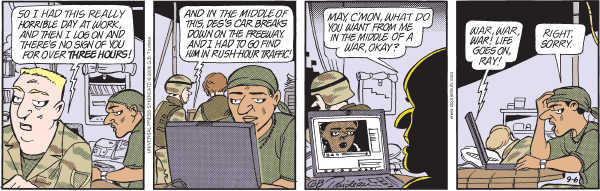
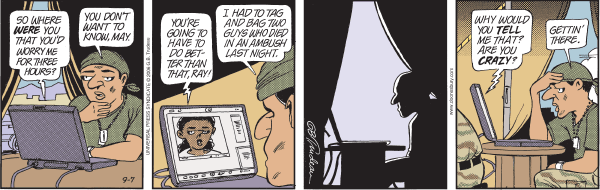
Cartoon Review: Doonesbury strips, first week of September 2006

(click on the strip if it's too small to read)


The series of Doonesbury strips from Monday, September 4th thru Saturday, September 9th offer a nice commentary on Twenty-First Century battle. Ray, a soldier stationed in Iraq, is stressed that he is late to spend the night on the computer with his wife at home, May. She gives him matronly hell, as if he was just home late from the bar (“You think I like throwing up?”), but of course with added gravitas because his absence could have meant so much worse. As the strips progress, he is caught up in domestic dramas, which are distractions from or as demanding as warfare (“No, clockwise, idiot! You'll break the damn lint filter!”)


It's an unusual approach to discussing Iraq, in our country torn by opinions & false dichotomies. Trudeau can wrap up so many ideas in a format which has to be four frames long, some sort of punchline in the fourth, & dispensed in the slowest serialization any national epic has ever seen. (I was obsessed in college about the issue of America's “National Epic”... In a country with so much great literature, what was our Imperial Equivalent to Homer? How do Salinger or Twain, bards with an American voice, fit into a democratic materialistic American epic mold? A national epic has to be written sometime around the origin of the empire, contain integrated discussions of all the artistic & political issues the empire will face, be written in a poetry to equal no other, & yet be above itself with an aware irony. After college, of course, I read Moby Dick, & that settled the matter. But then what of Doonesbury? Can the American epic really be in novel form, when we would sing to the muses mostly in multimedia? Doonesbury chronicles America during the crucial era, commenting in depth & subtlety on American culture & politics in short daily installments from the sixties thru today, with dozens & dozens of main characters who have grown & continue to evolve. It could also be argued that the past forty years have shaped our empire more than the mid-1800s did... I could conclude that if Melville is our Virgil, than Trudeau is our Ovid.)


Doonesbury, with its “liberal bias”, manages to entertain & touch most Americans with the employment of several central techniques. First, its famous “love of the soldier / hate the war” attitude. Second, is it's remorseless critique of any politician, not just the Bushes. How followers in all demographics of America interpreted the first week of September's comics reveals the complexity of his vision. Larry Beasley from Milwaukee wrote to Trudeau:


Ray's email strips point something out (at least to me). It seems we as a nation are not taking this war seriously. I'm not old enough to remember the WW II rationing system or the mandatory recycling, and the draft ended during my last year in high school. Shame on me for not getting more involved. Considering the hardships soldiering brings with it (some of our troops have to pay for their own armor -- shouldn't it be standard issue for all combat/hazardous duty personnel?), shame on us all. Whatever victory may still be achieved, it will require more than cheerleading and empty expressions of support. God save the Republic.


He interpreted May's attitude as a stark contrast to how we idealize World War Two's civilian dedication & sacrifice. A woman from Temecula, CA, Stacy Swenck, meditated on the historical implications of e-mail versus letters:


Last week's series of strips has caught my attention like no other. I lost my dad, Robert Swenck, to Vietnam in 1971. I was only twelve when my dad died, and a few years ago I finally read the letters (about 100) he sent to my mom before he was killed. I only got to know my dad through those letters since my mom rarely mentioned him after he was killed. I worry that the families of today's soldiers are communicating through ephemeral means, and that there will not be letters left over for the kids to read when they grow up.


And a mother from Tuscan, AZ, Heather Deaver, compared it to her own paranoid experience, which of course can be viewed in contrast to pre-internet wars:


I just wanted to thank you for the recent strip on soldiers emailing from Iraq. My son is a 23-year-old Lance Corporal in the Marine Reserves. He began his first tour last week, when your strip was running. I had to laugh because I was also freaking out if I didn't get an email every day. My son very patiently explained that there are only so many computers, they have to sign up to use them, and they only get 20 minutes and he has a lot of email! Thanks for making me feel not so silly.


Alternately, it contains various thoughts on marital relations, which span peacetime, wartime, & whatever sort of high-tech conflict we're in now. Comic strip authors of the stupid variety often gear their strips to hit a simple chord, like “ha ha, my husband always has the same shit luck when he golfs, too – I'll cut this out & put it on my fridge.” There's really no comparison to what Gary Trudeau is doing.


March 30, 2006

Music Review: Of the Monstrous Pictures of Whales; Of the Less Erroneous Pictures of Whales, & the True Pictures of Whaling Scenes; Of Whales in Paint

I have recently completed a three-movement sonata for solo marimba entitled “Three Chapters from Herman Melville’s Moby Dick; Or, The Whale”, which was composed at the behest of Mr Jonathan Shapiro. It was conceived whilst on the California Zephyr train, slowly descending out of the Rocky Mountains along the Colorado river, earlier this month. In the beginning of January, I sat awake for twenty-two of the twenty-five non-stop hours of the annual Moby Dick reading at the whaling museum in New Bedford, Massachusetts, so located because that’s where the book begins (except it actually begins penniless in a noisy New York City). Hearing this bizarre book out loud, without a pause, with over a hundred readers ranging from the eloquent to the stuttering, whale bones hanging abovehead, was quite an experience. As any familiar to the book will know, after about a hundred pages (four hours), & the ambiguous narrator is aboard the Pequod, the plot simultaneously heightens & disintegrates. There are long rambling chapters about the grace of whaling, the majesty of whales, written in a parodic sublime, which is both tongue-in-cheek & massive – I mean, both ironic & not – I mean, both a joking pseudo-academic blabber, & language with a Shakespearean grandeur & Miltonic range of allusion.

I think the three chapters about images of whales – chapters LV thru LVII – come at a pivitol point in this narrative disintegration. Melville has completely outlined the basic dramatic structure, & ruminated on the deepest mysteries inherent in the boredom of a three-year voyage, & now that that boredom has set in, eleven hours into a non-stop reading, he wields his long sentences to attack all those who can’t illustrate a whale correctly, the dorsal fin is in the wrong place, &c. I can’t help pitying those who are forced to read this in high school, weary after hours of algebra, physics, & whatever-else homework, & Melville is still ambling on about bones. I cannot imagine very few readers approaching these chapters with a proper mind to appreciate them. But when you come at them with a maturity, a postmodern distance, & perhaps that majestic tedium that being on a changeless ocean, or a train, or lying awake in a whaling museum non-stop on a cold tile floor, I think these chapters are really fucking funny.

But the placing of the cap-sheaf to all this blundering business was reserved for the scientific Frederick Cuvier, brother to the famous Baron. In, he published a Natural History of Whales, in which he gives what he calls a picture of the Sperm Whale. Before showing that picture to any Nantucketer, you had best provide for your summary retreat from Nantucket. In a word, Frederick Cuvier's Sperm Whale is not a Sperm Whale, but a squash. Of course, he never had the benefit of a whaling voyage (such men seldom have), but whence he derived that picture, who can tell? Perhaps he got it as his scientific predecessor in the same field, Desmarest, got one of his authentic abortions; that is, from a Chinese drawing. And what sort of lively lads with the pencil those Chinese are, many queer cups and saucers inform us.
-ch. LV, “Of the Mountrous Pictures of Whales”

On the train, with the cud-chewing & gentle rocking thru the Rockies, I thought of the post-Minimalist music I’ve been writing, inspired by the Bang-on-a-Canners, New York hipsters, a lot of it (both their’s & mine) quite boring, indifferently, with a lot of imprecise repetitions, a consistent texture, with the whole of notated Western music (along with popular & world musics) to draw from in reference, often ironically & in dense combination, but the pretension fully cohesive, destined to promote eye-rollings if the audience can actually pay attention. Well, at least the loose rhythms, (a lot of vague 2s & 3s to create a rhythmless, improvisatory atmosphere, like in David Lang’s Little Eye), feel somewhat aquatic, rocking, like a road-trip movie. The modernists found Melville relevant, & fully revived him in the ’20s, & there he’s sat at both the foundation & margins of American art; & then the postmodernists re-found him, & I’m sure I’m not the first to find a relation between the marginalized 21st-century hipster-ass classical music (which is a sort of genre-less post-postmodernism, often self-aware at its own self-awareness), & the deepest ambiguities in Melville’s narrative voice. I gave my piece a dose of the Americana harmonies, reminiscent of Copland & Ives, kept the rhythms in those swaying 2s & 3s of David Lang, but the voice is Melville’s.

February 26, 2006

Pictures of Myself; Or, The Ambiguities

In front of me lies a copy of Melville’s forgotten novel, Pierre; Or, The Ambiguities - among other objects, of course. This edition, checked out today from the Cornell University Library, contains a host of dirty illustrations by Maurice Sendak (of Where the Wild Things Are fame), every one of which accentuates the sexual regions of the subjects, & not subtly. The titular character wears a red cape & a monochrome blue onesy, every perfect muscle exaggerated thru the clothes like a Blake Illumination. As Melville lovers love to find innuendos in his books, there is much hidden sexual content, sometimes repressed, sometimes easily extracted from ambiguous imagery (“the waves curling & hissing around us like the erected crests of enraged serpents.” -Moby-Dick), sometimes blatant. I’ve only heard one Sendak scholar give a lecture, at a Lewis Carroll Society conference in Princeton, & he spoke at length about these series of dirty cartoons of Alice, which looked to me more like doodles, where she’s screwing the rabbit, &c.; then he set to a Freudian reading of Higglety Pigglety Pop!


Pierre so far has a lot for Sendak to be Freudian about. Pierre doesn’t have a sister, so he insists on calling his widowed mother “Sister Mary”, & they have quite a flirtatious relationship. She, in return, much admires her own beauty in his. (Later, after much meditation on his father’s nature, he realizes that he is his father... see the quote at the end of this posting.) Pierre is affianced to a gay little blonde named Lucy, & his life seems to be on track, but he keeps thinking about this face he once saw. (In typical Melvillian psychology, fifty or so rambling & excited pages are devoted to the nature of obsession.) The face in question is a girl’s, full of haunting, lovely sorrow (“...he seemed to see the fair ground where Anguish had contended with Beauty, & neither being conqueror, both laid down on the field.”) Of course, the reader thinks he must have some dark crush on her, but then he receives a letter from her in which she admits to being his cursed bastard sister. Of course, his obsession is somehow rooted in the mysteries of ancestry, already a prominent theme in many of Melville’s tangents. The bachelor life of one’s father is one of those existential impossibilities, failures of the imagination to know the truth, like Shakespeare’s Leontes on the impossibility of inalienable certainty that you are the biological father of your children.

Anyway, Pierre then unravels the mystery in his mind, based on what little he knows of his father. The are two portraits of his father, one large public one which his mother prefers, & another one which, because of her dislike, Pierre keeps hidden in his closet. There is something mysteriously ambiguous about it, & his aunt told Pierre her brother was tricked into sitting for it, back in the days when he was courting this French girl whom the town thought below his marrying. His artist cousin had pretended to be painting something else whilst the elder Pierre told of his exploits. & altho his mother probably never knew the story of the picture; hence, why she didn’t think it was a very good likeness of him - she never saw that side of his face! Why, Aunt Dorothea, did he initially resist being painted?

[The artist Cousin Ralph] “‘used to tell me, that being in your father’s room some few days after the last scene I described, he noticed that there was a wonderful work on Physiognomy, as they call it, in which the strangest & shadowiest rules were laid down for detecting people’s innermost secrets by studying their faces. And so, foolish cousin Ralph always flattered himself, that the reason your father did not want his portrait taken was, because he was secretly in love with the French young lady, & did not want his secret published in a portrait; since the wonderful work on Physiognomy had, as it were, indirectly warned him against running that risk.’”

Revelatory faces, like the first one that possessed Pierre, which stir gloom into his pristine life, uncovering family secrets, often with perverse sexual overtones. All these conclusions on very little evidence - a gossipy aunt, a lonesome face seen once, a painting by an amateur artist. Melville himself casts doubts on the authenticity or reliability of these clues - again like the aforementioned Leontes, who needs no Iago to convince him of his wife’s infidelity & the bastardship of his son (“But to be paddling palms & pinching fingers, As they now are, & making practiced smiles, As in a looking-glass...” -A Winter’s Tale, I.i). Or, like Starbuck, vainly reasoning with Ahab that the evil is not in the beast Whale but in the human mind which projects it.

What then of the information age, where we are surrounded by millions of images with ambiguous glances & implications? Pierre needed only two to possess him. I once got in trouble for a picture taken of me in England with a drunk Welsh girl, with whom I had barely ever spoken. If the circumstances, emotions, dramas, behind the taking of the photograph were impossible to imagine to my current friends, what will my children make of it, or my poor biographer, or if the lost girl or any of her friends or relatives gets a hand on it, now or whenever. I think my innocence lies in the hesitancy of my right hand, not holding her in any familiar way. I can hardly recall what I was thinking or doing what itwas shot. Our faces are ambiguous.


"And now, by irresistible intuitions, all that had been inexplicably mysterious to him in the portrait, and all that had been inexplicably familiar in the face, most magically these now coincided; the merriness of the one not inharmonious with the mournfulness of the other, but by some ineffable correlativeness, they reciprocally identified each other, and, as it were, melted into each other, and thus interpenetratingly uniting, presented lineaments of an added supernaturalness.

"On all sides, the physical world of solid objects now slidingly displaced itself from around him, and he floated into an ether of visions; and, starting to his feet with clenched hands and outstaring eyes at the transfixed face in the air, he ejaculated that wonderful verse from Dante, descriptive of the two mutually absorbing shapes in the Inferno:

"Ah! how dost thou change,
Agnello! See! thou art nor double now,
Nor only one!"

February 25, 2006

List: Titles & Subtitles

Shakespeare: Twelfth Night; Or, What You Will (1599)
Shakespeare: Henry VIII; Or, All Is True (1613)
Melville: Moby Dick; Or, The Whale (1851)
Melville: Pierre; Or, The Ambiguities (1852)
Gilbert & Sullivan: The Pirates of Penzance; Or, The Slave of Duty (1879)
Gilbert & Sullivan: Patience; Or, Bunthorne’s Bride (1881)
Gilbert & Sullivan: Utopia, Unlimited; Or, The Flower of Progress (1893)
Kubrick: Dr. Strangelove; Or, How I Learned To Stop Worrying & Love the Bomb (1964)
Neal Stephenson: The Diamond Age; Or, A Young Lady’s Illustrated Primer (1995)
Albee: The Goat; Or, Who Is Sylvia? (2000)
(contributions welcome)

February 16, 2006

Quotes: Gay Americana

Upon waking next morning about daylight, I found Queequeg’s arm thrown over me in the most loving & affectionate manner. You had almost thought I had been his wife.
-Herman Melville, Moby-Dick, or The Whale (1851), Ch. 4, "The Counterpane"

He seemed to take to me quite as naturally & unbiddenly as I to him; & when our smoke was over, he pressed his forehead against mine, clasped me round the waist, & said that henceforth we were married.
-ibid., Ch. 10, “Bosom Friends”


The beards of the young men glisten’d with wet, it ran from their long hair,
Little streams pass’d all over their bodies.

An unseen hand also pass’d over their bodies,
It descended tremblingly from their temples & ribs.

The young men float on their backs, their white bellies bulge to the sun, they do not ask who seizes fast to them.
They do not know who puffs & declines with pendant & bending arch,
They do not think whom they souse with spray.
-Walt Whitman, “Song of Myself”, from Leaves of Grass (1855)


I can’t make it on a couple high-altitude fucks once or twice a year! You are too much for me Ennis, you sonofawhoreson bitch! I wish I knew how to quit you.
-Jack Twist, from Annie Proulx’s Brokeback Mountain (2005, dir. Ang Lee)