July 18, 2006

E-mails: Three written today in Alameda

Date: Tue, 18 Jul 2006 11:50:27 -0700 (PDT)
From: "James Welsch" <__________@yahoo.com>
Subject:Thomas Stearns
To: "Grace Marlier" <__________@hotmail.com>

"By this grace dissolved in place" -T.S.

"There is a time for Thomas Stearns Eliot / & a time for my middle name" -J.H.

"Don't talk like a book, Dad." -Dolores Haze to Humbert Humbert.

Grace,

I saw the tallest lifeform on earth, the tallest tree, "Giant Tree" in the Humboldt Redwoods. It made me think of Melville. We're trying to find a place to live, in the "bay area".

Did you know that Liam & Virtue are in Brasil! Did you know it's winter down there, but not the white kind. Jenny just told me: "you should write her back like you're a black person, too." I suggest that your entire nice, despite street-wise, e-mail to me was a formality to get Liam's information! Well it didn't work, my liege! Except that I think he does now possess an electronic mail address, including all of his middle names, ljowg at yahoo dot com. He refuses to answer my inquiries regarding the dubya. Thomas Fucking Stearns! Bah! Joanne Kathleen? I love her. L.J. Olaf W.G. contacted me trying to find postcard locations for Ben, Hannah, Melinda, Rachel, of which I had none, only e-mails for two. He falls off the face of the planet & then expects everyone to resubmerge from Atlantis when he's lonely in Latin Land? The scoundrel!

I'm house-sitting for my sister in Alameda, a carefully preserved mid-century community (tupperware & nuke scare) sausaged between "The City" & "The East Bay". We plan to use this old house as a haven while we do our reconnaissence into scary Berkeley, our perhaps new hood. Everyone has a different idea for me. All I want to do is stay in the mountains & live the life of the idle rich. Cosmic forces conspire to move me to urban Dis. Count me momentarily 'in' on B.A., despite the rigamarole which will keep me from you.

Peace & Robert Allen Zimmerman,
J.H.

______________________________________________________________________________________


Date: Tue, 18 Jul 2006 11:16:09 -0700 (PDT)
From: "James Welsch" <________@yahoo.com>
Subject: Le
To: "Bonnie Whiting Smith" <____________@gmail.com>

Bonnie Anne,

First, some initial thoughts about the Jabberwock:

I recommend immediately securing a copy of Martin Gardiner's amazing "The Annotated Alice" which contains the most thoro introduction & footnotes to both Alice Books. The section on the Jabberwocky is pages of footnotes, definitions, & translations. I just found the wikipedia entry, which also has definitions & more translations.

http://en.wikipedia.org/wiki/Jabberwocky

It also has a long section on pronunciation, which you may want to study! before pronouncing it "wrong" for a bunch of nubiles.

The French:

Il brilgue: les tôves lubricilleux
Se gyrent en vrillant dans le guave.
Enmîmés sont les gougebosqueux
Et le mômerade horsgrave.

Several suggestions for other things you can do or add to the play:
I would recommend using the Humpty-Dumpty dialog as a framework, because it's hilarious & explains the idea of a portmanteaux. Perhaps you could make a humpty-dumpty costume into an instrument!

Look into Joyce's Finnegans Wake - it quotes the Jabberwock repeatedly, & the whole book is inspired by Carroll's innovation of the portmanteaux. If you were interested in quoting other nonsense besides the Jabberwock, perhaps you could sing the quotes from FW. (I'll look them up for you). The major themes of the Joyce are the toppling of the tower of babble-babel-baba, i.e. the nonsensization of language, & it is overlapped with the fall of Carroll's Humpty-Dumpty, & fall of drunk Tim Finnegan from the old Irish song. (Finnegan falls off a ladder & wakes up at his own wake, i.e. Jesus. The whole nonsense novel is supposed to be his dream-death-drunk.) Look for references to Humpty-Dumpty on the first page!

If you're interested in other nonsense verse, there's a good dover edition of Carroll's complete poetry. You might want to include the "Mad Gardner's Song" to your act, always a favorite. Edward Lear is the other famous nonsense poet. I also love Robert Burns, the Scottish bard, & I was going to send you this poem I recently found:

Ye gallants bright,
I rede you right,
Beware o' Bonnie Ann;
Her comely face sae fu' o' grace,
Your heart she will trepan:
Her een sae bright, like stars by night,
Her skin is like the swan;
Sae jimply lac'd her genty waist,
That sweetly ye might span.

Youth, grace, and love attendant move,
And pleasure leads the van:
In a' their charms, and conquering arms,
They wait on Bonnie Ann.
The captive bands may chain the hands,
But love enslaves the man:
Ye gallants braw, I rede you a',
Beware o' Bonnie Ann!


Secondly, our party:
It was mostly people from my work, afterall, plus James Quill & Darren Southworth, my only old friends who made the journey. Three of my ex-coworkers got into a dramatic threesome, rife with yelling & crying, which complicated my simple festivisties. Jenny & I are looking for a place to live in the bay area, house-sitting for my sister in Alameda this week. We were just up in Ashland, Oregon, seeing Shakespeare's King John, & then camping in the redwoods. We saw the tallest tree in the world, the tallest life-form on eath, "Giant Tree", a humbling experience; then drove down the coast, beautiful! I'm reading Nabokov. More later - stay in touch - I have help my sister with the newest baby, one month old, baby Will, already twelve pounds.

Love,
James Henry


_______________________________________________________________________________________________________


Date: Tue, 18 Jul 2006 13:52:32 -0700 (PDT)
From: "James Welsch" <_______@yahoo.com>

Subject: P.S.
To: "Bonnie Whiting Smith" <__________@gmail.com>

I found the great lecture I saw, where I was first introduced to the Carroll-Joyce connection:

http://www.lewiscarroll.org/bander.html

Scroll down to the section called "Joyce Carroll Notes" for the quotes.

But, if you have time, that whole essay might give you a lot of inspiration & suggestions. Also, I can put you in touch with Mark Burstein if you want to ask him for ideas. There's already been a lot of music/theater/addition writing about the Jabberwocky, & I'm sure he knows everything inside out. There's also a movie based on it from the 70s, directed by Terry Gilliam (Monty Python / Brazil).

Too much information?

James

July 02, 2006

Music Review: 10 Suggestions for Summer Listening! Part I

Here I present five of ten albums in various genres, hand-picked from the very favorites of my music collection. Some of the hyperlinks are audio samples, powered by Amazon.com.

CLASSICAL

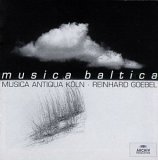
Musica Antiqua Köln (directed by Reinhard Goebel) – Musica Baltica (1999)

This could become an essential album to anyone whose music collection lacks obscure composers of the Baltic Mid-Baroque (late 17th Century). It is also, hands down, the finest early music violin playing I have ever encountered, led by savant-genius Reinhard Goebel. He guides his ensemble thru the frolicsome flares necessary to any well-researched project of period-instrument Baroque performance, but one never feels bogged down in the mordents. He has also introduced me to some of the most haunting & unusual music. It is a long album, but don’t miss the final tracks, with two by Johann Valentin Meder, the controversial Danzig Kapellmeister. The Sonata di Battaglia begins with triumphant C-major chord which saws away for a solid two minutes before changing! Also, the regal trumpets & bassoons on Vincenzo Albrici’s Sonata a 5 continue to move me, after years of repeated listenings, to minuetting around the room.

_________________________________________________________________________________


Dawn Upshaw – Osvaldo Golijov: Ayre, Luciano Berio: Folk Songs (2005)

Stand up for the Crossover disc of the decade! The pairing of Berio's 1960's take on combining world folk genres with contemporary classical innovations, with Golijov's 21st Century attempt, leaves a lot to think about. Golijov is the Jewish-Argentinian-American who did all of those amazing, yet popularly denounced, arrangements for Kronos Quartet's Caravan (gypsy) & Nuevo (latin) crossover experiments. (Kronos fan-purists would prefer them to keep with the heady academic program, but really they're just keeping up with more realistic trends & innovations - their newest album is all from Bollywood soundtracks.) Golijov's own music, for instance in Ayre, has a ton of integrity whilst dipping into every imaginative world idiom. Clearly, if the 21st century offers any direction, it's welcoming inspiration from the sheer bulk of recorded music available, & relishing in its ability to be blended in the genre of notated concert music. Berio's Folk Songs have been recorded dozens of times, but this ensemble is especially tight, & the piece has really worn well during its transition from contemporary classic to over-preformed classic-proper. Dawn Upshaw, I think, is one of the most amazing vocalists alive. She can keep her day job at the conservative Metropolitan Opera while preforming the classiest new music & anything else she wants to: Weill, Bernstein, Ives, Berg, Adams, Purcell, Stravinsky, &c. Her voice is really just an instrument of her intelligence, tastely borrowing slides from jazz, an occasional hugeness from Wagner, & deepening it with her own gravity or lightening it with her wit. Golijov's music allows her to showcase a new breadth, replete with sufi trills, or whatever the music calls for. As for Berio, "I wonder as I wander" has never sounded so beautiful.

_________________________________________________________________________________


Kevin Volans - White Man Sleeps (1990)

1980s British Minimalism is one of the sadly neglected genres of 20th Century Music. Graham Fitkin, for instance, perhaps suffers from a contemporary embarrasment for cheezy synthesizers. His seminal Cud (1988) perhaps sounds a bit too much like The Muppets Take Manhatten. Many recordings by Fitkin have not been reissued - (Look for Argos CDs in used record stores!) Volans, however is the opposite in aestetic - his music is extremely earthy. A white South African native who moved to Dublin, several of the pieces on this album are for two harpsichords tuned liked African thumb pianos (a compositional risk, I assume, severely limiting performance possibilities). Kronos Quartet has recorded the string quartet version of White Man Sleeps, an arrangement of the version on this album for two harpsichords, viola da gamba, & percussion. The Smith Quartet preformance on this album, I cannot emphasize enough, rocks so much harder than Kronos. Really, man, this is some of my favorite music. Like Steve Reich, it clearly links '70s-'80s Minimalist form to traditional African counterpoint, written for early Western instruments, & performed with a lot of heart.

______________________________________________________________________________


Steve Reich - You Are (Variations) (2005)

I am curious how Reich-virgins might approach this music, because, more than ever, he is building on a career's-worth of innovations. It has the form of Tehillim - (two two-part movements, lots of soprano-cannon-lines sung in hebrew, third movement slow). It has the thick piano writing of several earlier pieces, but his dissonence has deepened, like in Four Quartets. It has similar repetitive-philisophical-text-setting as The Desert Music & Proverb. Melodically, the second movement of You Are starts with a jumpy-hebraic melody reminiscient of Tehillim, which gets dissected in a way similar to The Desert Music, so that the words are slowed down into luscious chords, amidst thick pulsing pianos & percussion. I feel that Reich has yet to really disapoint, nor are developments of previous ideas ever boring (or, like Glass, pathetic.) This piece, despite borrowing from an entire career, feels fresh, original, & even a tad rebelious. His mystic-contemplative side is as deep as ever, his harmonies as luscious - everything - his pace, ochestration, drama, everything that makes music good, is of the finest quality. I guess one should consider this an excellent piece of music grown from a carefully developed style, which has evolved over four decades. Also, on the same album, is Maya Beiser's performance of his latest Counterpoint, Cello Counterpoint, a series of pieces where one instrumentalist plays on top of herself twelve-or-so times. This has by far the fastest changing structure & some of the richest harmonies of any of them. It's beautiful, recorded with gorgeous production.

_____________________________________________________________________________


ROCK / COUNTRY

Emmylou Harris - Wrecking Ball (1995)

In September, we'll be celebrating the 11th anniversary of this seminal album. What links it to 90's country music, or 90's rock? I don't know. It sounds more to me like someone has stuck this album in a future capsule from 2050, where Emmylou's plastic head has been preserved in a laboratory. Her voice is both alien & earthy. It aches as Jesus must have, yanked between two universes. The lyrics of the songs she chooses to sing are like a snow plant, organic but a seeming stranger - "And if you were Willie Moore / And I was Barbara Allen / Or Fair Ellen all sad at the cabin door /A-weepin' and a-pinin', for love / A-weepin' and a-pinin', for love." It's really the production that makes this music so special, tho. Daniel Lanois, who has also worked with Bob Dylan, U2, & Peter Gabriel, matches Harris' alien-earthy dichotomy with his own magic. What is the "wrecking ball"? Is it what happened to the rolling stone? A symbol for one generation, which began as aimless, & ended somewhat heartless & destructive? Neil Young sings back-up on his own song, "meet me at the wrecking ball / I'll wear something pretty & white / & we'll go out dancing tonight." Every song carries a subtle mystical overtone, subtle even when she's singing directly to her "savior". Her version of Gillian Welch's "Orphan Girl" is my favorite of this oft-covered song. (I sing it with a ukulele). &, of course, "All My Tears" is one of the most beautiful things ever recorded.

June 30, 2006

E-mails: Conversations with Ben Ricker about the latest books by J.K. Rowling & Jonathan Safran Foer [Warning: this discusses the end of both novels!]

Date: Thu, 29 Jun 2006 17:12:13 -0400
From:"Benjamin Ricker" <_______@gmail.com>
To:<_________@yahoo.com
Subject:

james,

i started reading a book by th white. wait, i started reading it when we were neighbors, but i put it down in order to read harry potter 6. i have made a more commited effort into the Once and Future King. its hysterical. i have a feeling you'd really enjoy his sense of humor. i was looking for a little information about the author. his other books sound irresistable. one entitled Goshawk is about his "ill-fated" attempts to become a falconer.

harry potter 6: are they really dropping out of school to chase down death eaters? what?

and snape? how could that be? dumbledore trusted him. how did he manage to fool dumbledore for all those years? i liked snape as the anti-hero. kind of mean and sinister, but in the end could be counted on to do the right thing. i find that, and i think we have talked about this, death in the harry potter books is kind of perplexing. the aveda-kadavera curse is just so abrupt. cedric's death took me a while to grasp. sirius just sort of slipped into an abyss. its so vague. so much of the magic in the books is reversable. plus albus was so sort of all-knowing. i sort of wish that that suprise hadnt been ruined. but its like luke skywalker and darth vader. you cant keep that underwraps for very long.

it took about 300 pages before i found myself enjoying the 6th book. the 1st hundred pages of all the books are about how bored and miserable harry is at privet drive and then being collected to go off to hogwarts. i guess i noticed it more because i had just finished the previous book. the pensieve flashbacks of tom riddle's young life were exciting. the 7th book has a lot of ground to cover if it indeed is the final installment.

extremely loud & incredible close: the first pages cracked me up and last pages had me fighting back tears. oscar schell was totally convincing. i can think of a few books that try and succeed at building a believable perspective of a child narrator. he's over smart and a lot like a miniature adult, but the frustration and helpless feeling that comes from being little, i think, is what makes him seem real. i didnt very much enjoy the sections written by his grandparents. their language was overly poetic and flowery. it could be unfair of me, but it just doesnt seem like old people to write like that. it seemed more like young people's writing. i liked the inclusion of photographs and blank pages. i caused me to read it slowly which i think is what safran-foer wants. its a pretty emotional story that should be read slowly and carefully.

[...]

are you still in the mountains? i really miss the mountains. i was feeling heavy nostalgic about them recently. about camp and stuff. but i soon realized that the things i miss about camp are no longer there. [...] but i miss you and jenny being my neighbors and our porch and drinking butterbeer. matty's idea to hold down the point was a smart one that we should have taken more seriously.
love,
ben
___________________________________________________________________________________________

Date: Thu, 29 Jun 2006 17:01:32 -0700 (PDT)
From:"James Welsch" <_________@yahoo.com>
Subject: Cocteau & Cluseau
To:"Benjamin Ricker" <________@gmail.com>

Dear Ben,

Did you read the stuff about R.A.B.? In the end, I thi
nk the Snape issue has to do with the morality of children's literature. If he's a bad guy, then the moral is, you can't trust anyone, not even Dumbledore. If he's a good guy, then there is strong moral of trust in friendship, obviously one of the things she's been going for all along. Also, Harry's pretty dumb to want to go at it solo. Hasn't he learned anything? If he has to destroy four or five horcruxes in the next book, each one like a mini Voldemort, it's a lot to do by himself. Trust & Friendship. & Ginny & Hermoine are some pretty powerful witches.

I felt very strongly about the Extremely Loud book after I finished it last year, like it was a contemporary classic destined to become a classic proper. Since then I've been more defensive & confused about it. Also, I daydream about teaching it to a high-school literature class, bringing out elements o
f 21st century literature in a fairly accessible book. I didn't like the grandparent's chapters the first time either (because mostly you're wanting to get back to Oskar's chapters), but when I read it out loud to Jenny, those choked me up the most. Stylistically, I think there's some important things going on: 1) hipster authors have been using pictures & graphs for awhile, but this time it seems more tasteful, less gimicky. 2) Existentialists turning into aburdists & postmodernists always had an athiestist meaninglessness-of-life disconnection of symbols. I mean, if there was a detective-trope looking for the solution to a mystery, things might be connected in a meaningless way (like Oedipa Maas in The Crying of Lot 49), & things might spiral out into a despair, or a "find your own meaning in life". What's cool about this book is that it seems to be building on that genre, but absolutely everything is interconnected. He's on a totally quixotic search (to find the lock to a key in Manhatten), but almost every detail in the novel stems somehow from the central theme - losing a loved one during a major, unneccesary civilian massacre. Love & War. Also, the idea of collecting things, & writing letters to people you love. Did you figure out why he always wore white? Becuase, in the the hiroshima bombs, the black lettering on white paper was burnt out, saving the white. & he was vegan because he didn't want to eat anything that could have been someone's father.

Well, we spent the day on the beach. I swam around in Tahoe for awhile, which was totally quenching. Now I'm drinking Sierra Nevada, wondering how I'm ever going to get this place cleaned before my father drives up tomorrow. We want to move to the Pacific Ocean. I miss the Point, too, dearly, but
it was a season of complex, subtle emotions. I still have nightmares about [...].

[...]

Keep in touch. I want to hear post-camp gossip. Israel Potter [by Herman Melville] is a fast-paced adventure, which I'm reading very slowly - full of ironic patriotism, hubris, sea battles, parodys of figures like Ben Franklin, & innocents abroad.

Peace,
James

______________________________________________________________________________________________

Date: Fri, 30 Jun 2006 09:16:10 -0400
From:"Benjamin Ricker" <________@gmail.com>
To:"James Welsch" <_________@yahoo.com>
Subject: Re: Cocteau & Clusea

james,

before this gets too out of hand: because dumbledore is sort of all knowing, you think it might be possible that he knew what snape was going to do and allowed it to happen? that it was planned between the two of them? then why not prepare harry for it somehow? perhaps i have missed your point. how is it possible that snape is still a good guy? its amazing to me how much study goes into learning the identity of R.A.B.. i was sort of content to wait for the next book. i'd recommend that harry stay in school. death eaters are always killing experienced aurors. what makes harry think he stands a chance?

back to Extremely Loud:
yeah, i didnt see the photos as a gimick either. it crossed my mind at first. the pages that were meant to be from thomas schell senior's communicating pad carried the same weight. i thought they were important. i may have mentioned this in the previous email, but those pages slowed me down. in a good way. they served to set a relaxed and patient pace for reading the book. its been a while since i have read a book with as much gravity. by the end i was sort of blazing through it at top speed and feeling guilty for doing so.
ok, the part of the book where bombs are imagined in reverse. bombs collecting fire and destruction then jumping back into the bellies of planes which fly backwards etc etc. i have encountered that image a handful of times recently. i know joseph heller uses it in catch 22. thomas pynchon uses it in gravity's rainbow. why is that so common?

i like the pacific ocean. rather, i am pretty much captivated by it. its funny, the atlantic ocean doesnt really effect me very much. the pacific ocean has a much different power. i lived at the pacific ocean in san francisco. its really too bad that i didnt take to that city because i really enjoyed having the ocean near by. i think i'd like to live in oregon or washington state sometime soon.

post camp gossip? man, i knew little of what was going on even when it was happening around me.

[...]

please let me know about music events. oh, i played some "acoustica" for a friend-exgirlfriend. she studied at eastman and claims also to know some of the composers on that compilation. what a small world.

love,
ben

_________________________________________________________________________________________________

Date: Fri, 30 Jun 2006 08:38:39 -0700 (PDT)
From:"James Welsch" <__________@yahoo.com>
Subject: Alarms
To:"Benjamin Ricker" <__________@gmail.com>

Ben,

I'm watching Germany-Argentina play in the World Cup Quarterfinals.

A lot of people I went to high school with went the Eastman route. My friends are Caleb Burhans & his wife Martha who play strings & sing for Alarm Will Sound. They're also on that Steve Reich Tehilim I gave you on the mix. Caleb arranged the "Cliffs" one, which I think is really beautiful.

How Snape still might be a good guy:
He was under contractual obligation (unbreakable curse) to protect Draco, plus he was surrounded by death eaters, & killing Dumbledore was what it came down to to protect himself, despite his allegances. It is very possible that Dumbledore would have previously discussed with Snape this eventuality, & in his humility, would have considered Snape more important to remain alive than himself.
Is it possible that he is a true double agent, too deep now in both sides to have preferences?

Slaughterhouse Five has the backwards bombs things also. I guess it occured to a lot of those guys who witnessed so much bombing.

Go Germany? Argentina?
James
____________________________________________________________________________
Date: Fri, 30 Jun 2006 08:40:20 -0700 (PDT)
From:"James Welsch" <_______@yahoo.com>
Subject: P.S.
To:"Benjamin Ricker" <_______@gmail.com>

Jenny finished HP6 last night, & she was crying & tossing & turning all night. She says she so mad at J.K.


Plus, didn't it seem like Snape was still trying to teach & protect Harry during their last confrontation. Jenny's pissed at Snape & doesn't believe me that he still could be on our side.

_______________________________________________________________________________________________________

Date: Fri, 30 Jun 2006 16:23:50 -0400
From:"Benjamin Ricker" <_______@gmail.com>
To:"James Welsch" <__________@yahoo.com>
Subject: Re: P.S.
she's pissed at rowling? i was pissed at snape. is that the same thing?

[...]

listen, i have always really liked snape. its hard for me to believe.
i cant really see how snape can still be on our side, but it would fit in jkrowling-nothing-is-what-it-seems-wait-n-see kind of way. it would take lots of explaining. are there any clues that snape knew harry was there watching? dumbledore put his undieing faith in snape. i guess that should be good enough for all of us. not just harry, but us readers too. you know what? i think i just convinced myself. i'm standing by snape on this one. tell jenny.

also, they'll hang a talking portrait of dumbledore in the headmaster's office. he's not gone like sirius is gone.


June 29, 2006

Quotes: Übermensch

"I love it when I'm around the country club, and I hear people talking about the debilitating effects of a welfare society," he said. "At the same time, they leave their kids a lifetime and beyond of food stamps. Instead of having a welfare officer, they have a trust officer. And instead of food stamps, they have stocks and bonds."
-Warren Buffett, second richest man in America, quoted in the New York Times, 26 June 2006. Buffett will be giving $31 Billion to the Bill & Melinda Gates Foundation.

“Lois Lane has always been one of the more boring figures in popular mythology: she exists to get into trouble. Margot Kidder tries to do something with this thankless part, but she’s harsh-voiced, and comes across as nervous and jumpy; she seems all wrong in relation to Reeve, who outclasses her. He’s so gentlemanly that her lewdness makes one cringe. (We aren’t given a clue to what our hero sees in Lois Lane. It might have been more modern fun if he hadn’t been particularly struck by her until she’d rejected his cowardly Clark Kent side for his Superman side—if, like any other poor cluck, he wanted to be loved for his weakness.)”
-Pauline Kael, reviewing the 1978 Superman for The New Yorker.

“Intentionally or not, the Jesus angle also helps deflect speculation about just how straight this Superman flies. Given how securely Lois remains out of the romantic picture in "Superman Returns," now saddled with both a kid and a fiancé (James Marsden), it's no surprise that some have speculated that Superman is gay. The speculation speaks more to our social panic than anything in the film, which, much like the overwhelming majority of American action movies produced since the 1980's, mostly involves what academics call homosocial relations. In other words, when it comes to Hollywood, boys will be boys and play with their toys, whether they're sleeping with one another or not, leaving women to weep, worry and wait to be rescued.”
-Manohla Dargis, “'Superman Returns’ to save Mankind from its Sins”, The New York Times, 27 June 2006. (It seems that she did not bother to actually watch the movie.)

The Usual Suspects was a game by comparison, and yet the Spacey figure in that film, Keyser Soze, was an infinitely tougher conceit than the Man of Steel; he was a man with the ambitions of a superman, and the extremity of that delusion made him at once venomous, elusive to the touch, and richly entertaining. After that, any actual superman was bound to be a bore. “Mankind is a rope fastened between animal and superman—a rope over an abyss.” That is Nietzsche, coiner of the Übermensch, and in “Thus Spake Zarathustra” he scorns what he calls “extraterrestrial hopes” in favor of those, rooted on earth, who struggle to overcome the weakness of their own humanity. That is a proper, if perilous, subject for grownup cinema, and I for one have grown tired of supermen, and superwomen, who start with such a flagrant advantage over the rest of us.”
-Anthony Lane, reviewing Superman Returns in this week’s New Yorker.

"Those who restrain desire, do so because theirs is weak enough to be restrained; and the restrainer or reason usurps its place & governs the unwilling."
-William Blake, The Marriage of Heaven and Hell

"The poor useth intreaties; but the rich answereth roughly."
-Proverbs 18:23

June 24, 2006

Editorial

Last night, as I was lying awake in my waterbed, I had an extensive series of mock conversations with Terry Gross, a recurring fantasy – I assume a recurring fantasy with much of liberal-artistic America, although I cannot prove it. Despite my attempts to keep this weblog “diary-free”, I have not posted in a while, & have not been inspired to write literary or cinematic reviews; or, as the painting instructor in The Muppets said, “Inspired! but by what?”

The first subject I was discussing with Terry was the wane of fine art. Is popular culture really art’s bane? An editorial in the New York Times was pointing out, that, of course, classical music, repeated heralded as deceased, has more houses & societies than ever, its popularity spans the globe, there are more composers, more money for orchestras & composers, & on & on. One could point out that Bach, an obvious example - who was a semi-obscure Kappelmeister, who wrote out-of-date music in his own style decades into the Rococo, & who was all-but-entirely forgotten for almost seventy-five years after his death – his audience now, including people who are only vaguely aware of his name & can perhaps hum a few of his most ubiquitous tunes, is probably larger than the amount of people alive on Earth in the early eighteenth century.

As for over-saturation of crappy music or overplayed music overwhelming new developments in the Contemporary Classical idiom, I am not so sure this phenomenon is new today. One can blame it on the amount of very dissonant or inaccessible music written in the twentieth century, but those artists loved what they were doing, so can hardly be blamed, & there was enough beautifully tonal & accessible stuff to give balance & attract an audience. True, the world has probably never seen an opera like Carmen so overdone as to exclude interest in the thousands of qualified recent American stage pieces. What bothers me more is the amount of college-educated intellectuals, fluent in literature & art, who have never heard of Copland or David Lang. It’s one thing to denounce John Cage or discuss him into the ground, but to never have let his name enter certain discussions shows a dangerous disregard for the growth of our culture. But obviously it’s not their fault if I was told about different things during my education than they were. The people I’ve been meeting in the mountains have at least a disconnected respect for Gehry, de Kooning, David Lynch; but music affects people differently. Difficult music is much more offensive, much more boring. Obviously, the population of young liberals who would be listening to Steve Reich are craving complicated music; & a lot of artists within “popular” idioms are writing music as deep in quality, & attracting these listeners, not necessarily away from so-called “fine art”, but blurring every boundary. This has all been said before, of course. Philip Glass (being interviewed by Peter Greenaway in the early ’80s) thanked the increased depth of recorded music’s sound for preparing a larger amount of listeners for complicated art music - he mentions the Beatles specifically - & therefore for widening his own marginal popularity. This was not new in the twentieth century, because the distinction between popular forms & classical forms was only as strict as it actually wasn’t in the twentieth century. But let’s face it, all manner of recorded popular musics have thick sounds. If Bob Dylan’s lyrics can serve as a “gateway drug” to appreciating dead white poets, then late Radiohead or Aphex Twin or Bjørk are serving the same purpose without accomplishing it – I mean, they are themselves satisfying the human need to listen to interesting things. Hip-hop, for instance, thru a swift two-decade evolution, quickly re-invented what poetry used to be, an oral manipulation & evolution of language. But it did not bring large inner-city populations (or their larger suburban audiences) to run & buy editions of Virgil. It created its own culture & itself satisfied mankind’s mystic desire to rhyme &amp; think in metaphor; its DJs satisfying our desire to listen to layered music. Meanwhile, Steve Reich, an American hero in fine art, is not properly glorified, his face does not appear on any currency, yet his record sales indicate that he is being appreciated by more ears than he would have had he been a composer of light opera in the nineteenth century.

June 11, 2006

One second of fame


We were at my parents' house for one night to prepare for house-sitting all month, & we got our picture on the front page of the local paper:
full article.

June 10, 2006

From the Archives: Poem written at dawn on the docks of Seattle, (Summer 2003?)

There is a time for Thomas Stearns Eliot
& a time for my middle name,
& with a clear sky in a breathless flame,
In the early morning of a Seattle flashlight,
Unfortunately, she’s not grown in the ways in which she might
(i.e. her mutable teenage romanticism),
& she has in the ways I thought she’d never fluctuate
(i.e. her stomach used to be so flat,
& where her chest was once – we’ll leave at that.)
My memory not my soul these changes irritate
& all my fantasies that left more future to create.
On that sunlit fish market her progeny’s dispersed,
& with a cup of sugary coffee I feel quite reimbursed.

There will be time to murder what three years have hid
& time to invent the shame,
& on a northbound bus without a name,
On that train a madman revives Poor Tom’s lost refrain;
With fortune, we’ll recover in recurrent pain
Her mutable teenage romanticism.
He sings to gluttonous hags as if they’d never slept,
(So where was pretty in them lunatic eyes
If angel sun a gilded guinea buys?)
New shadow to new substance all these changes irritate:
To see the moon, one must his head rotate.
The solid past & liquid fantasy exchange saliva now,
& air to air tomorrow melts like white milk from a chocolate cow.

June 05, 2006

E-mails: Male names beginning with 'S'

Date: Sun, 4 Jun 2006 16:59:11 -0700 (PDT)
From: "James Welsch" <_________@yahoo.com
>
Subject: Baby boy
To: "Annette Kelly" <__________@sbcglobal.net>, "Steve Kelly" <____________@sbcglobal.net>
CC:
"Suzanne Carol Welsch" <________@yahoo.com>, "John Henry Welsch" <_________@worldnet.att.net>, "Lee Welsch" <_________@earjuice.com>

Annette & Steve,

Congratulations on your healthy baby!

My friend here spells it "Shaun" which is my favorite spelling, although I don't know where it's from. Michael is the angel in Paradise Lost.

Some other of my favorite male names: Arlen (cowboy name / Republican senator), Melville (marginalized great American author), Roy (John's brother/cowboy), Blake (poet/prophet/cowboy).

There's a great names graph here.

If you click on "boys" & type in a "S" it will show you a crazy graph of the rise & fall of all of the S-names throughout the twentieth century. Sirius Black is the great character from Harry Potter. There's "Swift", as in Jonathan, or "Samuel" as in Coleridge or the King, "Spenser" wrote the longest poem in the English language, "Stravinski" wrote a ballet that caused a riot, "Serge" Prokofiev wrote an opera about a man who falls in love with four oranges, "Salvador" wrote books explaining his own symbolism.

& there's always first Chronicles in the Bible.

Just don't name him Madison. Or Nevaeh. Or Clement.

Love & Peace,
James

__________________________________________________________________________________________


Date: Sun, 4 Jun 2006 20:00:22 -0700 (PDT)
From:
"Sue Welsch" <______@yahoo.com>
Subject: Re: Baby boy
To: "James Welsch" <__________@yahoo.com>, "Lee Welsch" <__________
@earjuice.com>

James, the name has been chosen and it is William Michael. They will call him Will or Wills (Like Prince William). I have been at the hospital all day and am now home taking care of Anastasia and Scott, while Stephen spends the night with Annette and Will at the hospital. He is really cute. More later, because I have to put the kids to bath and bed.

Love, MOM